
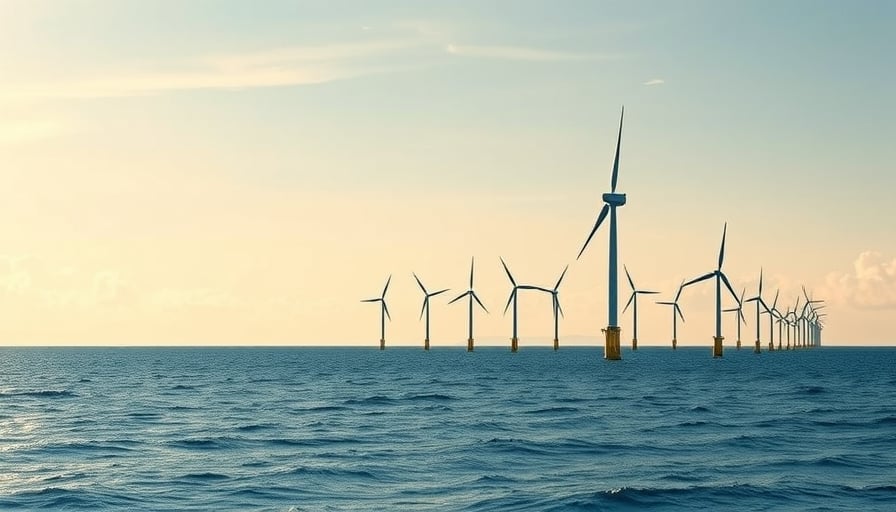
Ørsted’s Strategic Divestment of Hornsea 3 and Its Market Implications
Ørsted A/S, a leading developer, constructor and operator of offshore wind farms, has completed the sale of a 50 % equity stake in the Hornsea 3 project to funds managed by Apollo Global Management. The transaction, valued at approximately 39 billion Danish krone (≈ $6 billion), was finalized on 30 December 2025 and represents a pivotal milestone in the company’s capital‑allocation strategy.
Transaction Overview
- Asset – Hornsea 3, a 2,900 MW offshore wind farm located off the coast of the United Kingdom.
- Seller – Ørsted, retaining the remaining 50 % ownership.
- Buyer – Apollo Global Management’s funds.
- Consideration – 39 billion DKK, equivalent to €5.22 billion.
The sale follows Ørsted’s earlier announcement on 3 November 2025 that it intended to divest a half‑share of the project. The completion of the deal provides the company with an immediate infusion of capital, strengthening its balance sheet ahead of forthcoming projects and potential market volatility.
Financial Impact
The divestment delivers a sizeable cash cushion that can be deployed in several strategic directions:
- Portfolio Expansion – Ørsted can accelerate development of new offshore wind farms in the United Kingdom, Germany, Denmark, the Netherlands, the United States and Taiwan, where it already holds operational assets.
- Onshore and Bioenergy Growth – The additional liquidity can support the company’s onshore wind and solar initiatives in the United States, as well as its bioenergy and waste‑to‑energy ventures in Denmark and the United Kingdom.
- Risk Mitigation – By reducing its exposure to the Hornsea 3 project, Ørsted lessens potential operational and regulatory risks associated with a single asset.
At the time of the announcement, Ørsted’s share price stood at 122.35 DKK, within a 52‑week range of 102.823 DKK to 349 DKK. The influx of capital has already been reflected in a noticeable uptick in liquidity, with analysts noting a potential for upward momentum as the company’s market capitalization—currently approximately 159 billion DKK—gains stability.
Market Reaction
The market response has been mixed. While the transaction injected significant cash into Ørsted’s coffers, the company’s shares opened lower on 30 December, trailing a broader sell‑off that saw peers such as Genmab also decline from opening levels. The dip is attributed largely to lingering regulatory uncertainty in the United States, where Ørsted’s onshore projects face an unsettled political climate that exerts downward pressure on valuation metrics.
Financial commentators have highlighted that the Hornsea 3 sale is a “strategic liquidity play” rather than a divestment of a core asset, given Ørsted’s retained 50 % stake and the project’s long‑term revenue potential. The decision aligns with the company’s broader objective to balance high‑growth offshore ventures with a diversified asset base across onshore, bioenergy, and customer‑solutions segments.
Forward‑Looking Perspective
Ørsted’s leadership remains focused on advancing its offshore portfolio while ensuring financial flexibility. The Hornsea 3 sale demonstrates a disciplined approach to asset optimization, positioning the company to capitalize on forthcoming opportunities in the global transition to renewable energy. Analysts anticipate that the additional capital will accelerate the execution of the company’s “future‑proof” projects, thereby sustaining its competitive edge in the utilities sector.