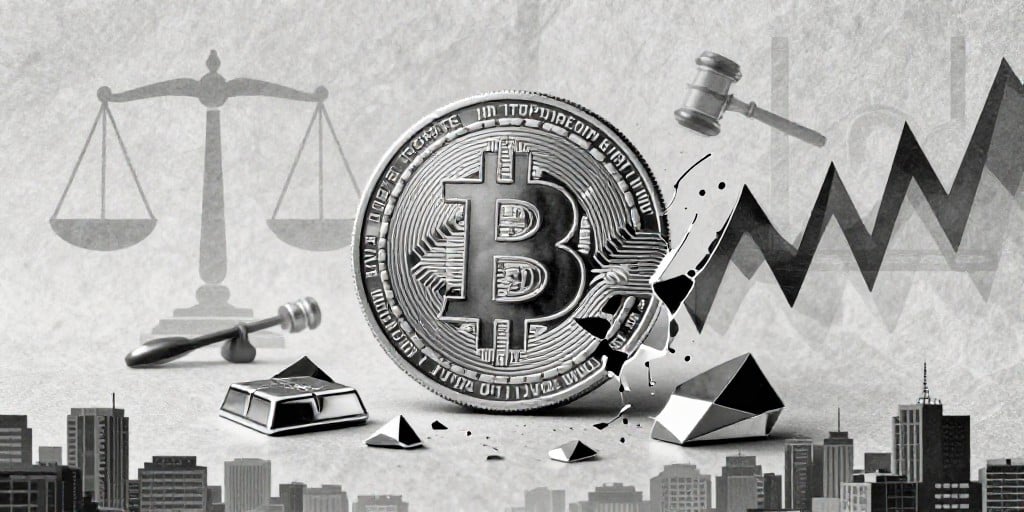
Bitcoin’s Position in a Shifting Monetary Landscape
Bitcoin, the most visible crypto‑currency and often called digital gold, faces a dual challenge: a new scientific breakthrough that could flood the world with gold and a surge of institutional interest in its financial‑utility side‑effects. Together, these forces are reshaping the narrative around Bitcoin’s role as a store of value.
The “Infinite Mint Bug” and Its Implications for Scarcity
A recent report from a U.S. fusion startup has announced that high‑energy neutrons from a deuterium‑tritium reaction can convert mercury‑198 into stable gold‑197. If the process is scalable, it would create a virtually limitless source of gold, undermining the precious metal’s long‑held scarcity. Bitcoin’s hard cap of 21 million coins appears unaltered by this discovery, but the question remains: does an “infinite mint bug” in gold erode the relative appeal of Bitcoin as a scarce asset?
Brian Armstrong, CEO of Coinbase, argued that Bitcoin’s fixed supply remains a decisive advantage. “There will only ever be 21 M,” he said, comparing the situation to the lab‑grown diamond industry, where new production does not increase overall scarcity. Yet, the narrative is more nuanced. If gold becomes abundant, its role as a hedge against inflation may weaken, potentially prompting investors to turn to Bitcoin for a more secure store of value. The timing and scale of gold production, however, remain uncertain, and Bitcoin’s current price volatility may deter risk‑averse institutional investors.
Institutional Demand Through Lending, Yield, and Balance‑Sheet Engineering
RootstockLabs’ latest analysis suggests a new wave of institutional demand could arise not from buying more Bitcoin, but from making existing holdings productive. At present, only 1.5 % of Bitcoin’s supply participates in lending and Bitcoin‑native finance, while institutional investors own roughly 3.9 million BTC. The report projects that if these holdings were leveraged for a modest 5 % annual yield, the collective return could incentivize more institutions to hold, and hold more, Bitcoin without altering its supply.
This model reframes Bitcoin from a static store of value to an active component in corporate balance sheets. By pairing BTC with fiat‑denominated liabilities, companies could potentially enhance liquidity and reduce financing costs. The analysis foresees a scenario where institutional holdings could double to 7.8 million BTC, with a 5 % yield driving additional demand. This is a compelling argument for Bitcoin’s long‑term viability: it can serve both as a reserve asset and as a source of revenue.
The Payments Gap: Why Bitcoin Is Still “Digital Gold”
Despite technical progress—more than one million U.S. merchants now accept Bitcoin through Square and the Lightning Network has simplified integration—Spiral’s report (backed by Jack Dorsey) cautions that Bitcoin is still not a day‑to‑day currency. The network’s volatility remains a barrier for consumers who prefer price‑stable instruments. Stablecoins such as USDC and PYUSD offer the convenience of a digital medium of exchange without the price swings that plague Bitcoin.
If Bitcoin continues to be perceived primarily as a store of value, its role in the everyday economy could remain peripheral. Spiral’s call for ambitious proposals over the next five years underscores the urgency: Bitcoin’s infrastructure must evolve to capture a broader segment of the payment market or risk being eclipsed by stablecoins that align more closely with consumer habits.
Synthesis: What the Future Holds for Bitcoin
- Scarcity Advantage: Bitcoin’s fixed supply remains a core asset, potentially strengthened if gold becomes abundant.
- Yield Potential: Institutional lending and yield‑generation could unlock a new source of demand, turning Bitcoin into a revenue‑generating asset rather than a passive reserve.
- Payments Challenge: Without addressing volatility and user experience, Bitcoin may continue to lag behind stablecoins in everyday transactions.
In the end, Bitcoin’s trajectory will hinge on whether it can simultaneously preserve its scarcity, monetize its holdings, and transform into a usable currency. The interplay of these factors will determine if Bitcoin remains merely digital gold or ascends to a true medium of exchange in the 21st‑century economy.