
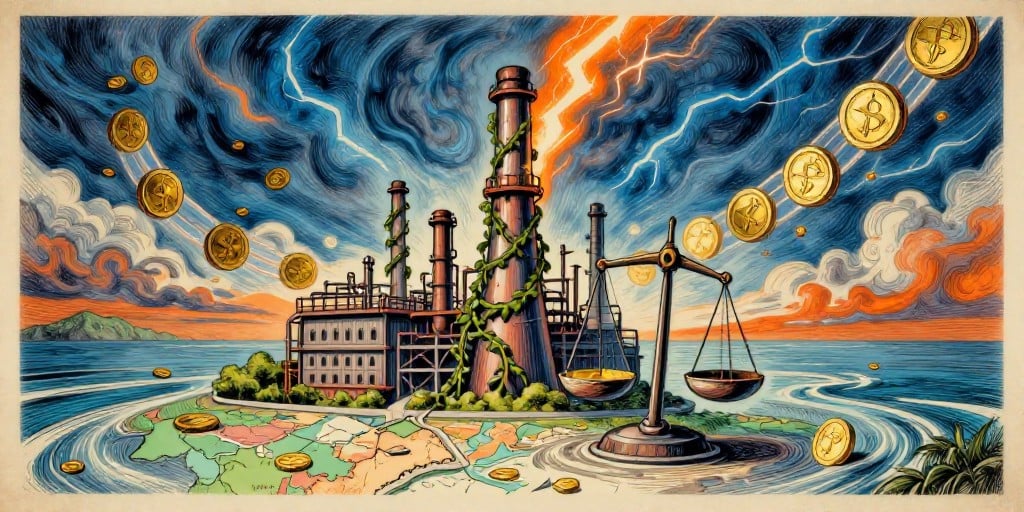
Braskem’s Financial Turmoil: A Reckoning in the Latin American Petrochemicals Arena
Braskem S.A., Brazil’s preeminent petrochemicals producer, is confronting a crisis that threatens to unravel its market position and corporate credibility. The company’s shares have slipped more than three percent after a board‑approved directive to file for an out‑of‑court debt restructuring, aiming to reorganise US$ 10.9 billion in outstanding financial obligations. This development marks the culmination of a tumultuous period characterized by environmental mishaps, falling commodity prices, and failed attempts by its controlling conglomerate, Novonor, to offload its stake.
The Trigger: Legal and Financial Reckoning
In a move that sent shockwaves through the Brazilian market, Braskem’s preferred shares (BRKM5) fell to R$ 4.91, a mere 3.16 % below their prior level and close to the intraday low of R$ 4.86. The catalyst was the board’s authorization for the management to file a petition for extrajudicial recovery—a legal mechanism that enables the company to negotiate with creditors outside the formal court system. The petition is slated to be formally filed once the requisite documentation is finalized.
The decision follows an agreement with the majority of its primary creditors, a prerequisite to trigger the proceedings. According to O Estado de São Paulo, Braskem had been under pressure to secure at least one‑third of its creditors’ consent before the Monday deadline, a threshold that would unlock the restructuring process. The company now has 90 days to hammer out the terms of the reorganization, a timeline that underscores the urgency and complexity of the task ahead.
Why the Storm? A Confluence of Headwinds
Environmental Disaster and Regulatory Scrutiny Braskem’s salt‑mine operations suffered a significant environmental blow, leading to a sharp decline in cash reserves and heightened scrutiny from regulators. The incident has not only eroded investor confidence but also imposed costly remediation obligations that strain the firm’s balance sheet.
Market Contraction in Petrochemicals A prolonged period of depressed commodity prices has eroded Braskem’s profit margins. As the largest producer in Latin America, the company’s earnings are highly sensitive to global demand fluctuations, leaving it vulnerable to macro‑economic swings.
Controlling Stake Turbulence Novonor’s repeated attempts to divest its controlling interest have introduced strategic uncertainty. The pledging of Novonor shares as collateral for 21 billion reais of loans further complicated the capital structure, creating a precarious nexus between equity holders and debtors.
Capital Structure Pressure The company’s market cap of R$ 3.64 billion sits precariously above its 52‑week low of R$ 3.81, while its price‑earnings ratio of ‑0.6 signals a negative earnings environment. The debt‑to‑equity ratio has surged, rendering the firm an unattractive proposition for risk‑averse investors.
Strategic Implications
Braskem’s decision to pursue out‑of‑court restructuring is not merely a financial maneuver; it is a strategic pivot aimed at preserving operational viability. By securing a stable legal environment, the company seeks to renegotiate terms with creditors, potentially reducing interest burdens, extending maturities, and, where feasible, converting debt into equity. This approach may avert a default scenario, but it also risks diluting existing shareholders and ceding control to creditor syndicates.
The market reaction—particularly the 2.56 % dip in Braskem’s preferred shares—reflects the collective apprehension that the restructuring could compromise dividend streams and long‑term shareholder value. Moreover, the broader Ibovespa index experienced a 0.97 % decline amid geopolitical tensions and anticipation of U.S. sanctions on Iran, amplifying the volatility in Brazilian equities. Braskem’s plight thus mirrors a wider sentiment of caution among investors grappling with macro‑economic and geopolitical uncertainties.
Outlook
The next 90 days will be pivotal. Should Braskem successfully negotiate a restructuring that satisfies the critical mass of creditors, it could stabilize its financial footing and regain investor confidence. Failure to do so risks a cascade of defaults, potential asset sales, and a further erosion of market value. Stakeholders—including employees, creditors, and the broader petrochemical sector—will watch closely as the company navigates this high‑stakes, high‑visibility battle for survival.
In a market where timing is everything, Braskem’s ability to balance creditor demands with shareholder interests will ultimately determine whether it emerges as a resilient leader in Latin America’s petrochemical landscape or becomes a cautionary tale of overleveraged ambition.