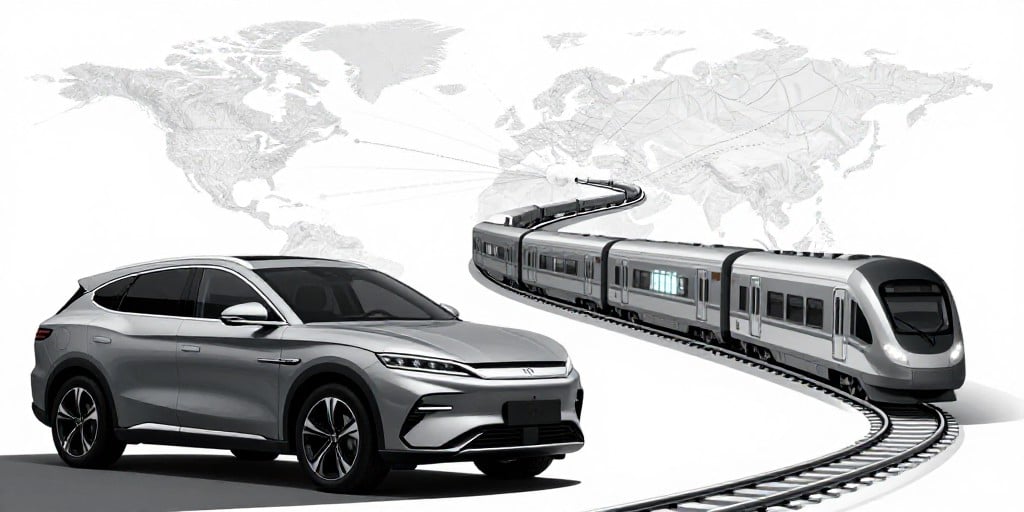
BYD’s Accelerating Global Expansion and Market Momentum
BYD Co. Ltd., a Shenzhen‑based automotive and battery manufacturer, has recently announced a series of strategic moves that reinforce its position as a leading player in the global electric‑vehicle (EV) and logistics sectors. The company’s stock, trading on the Hong Kong Stock Exchange, closed at HKD 79.85 on 10 September 2026, and its market capitalization exceeds HKD 728 billion. With a 52‑week high of HKD 269.97 and a low of HKD 71.40, BYD’s valuation remains robust in the face of sector‑wide volatility, reflected in a price‑to‑earnings ratio of 21.66.
Expansion of the Car‑Carrier Fleet
In mid‑September, BYD announced that it had purchased the world’s largest car‑carrier and placed an order for ten additional high‑capacity vessels. The move, reported by electrek and IT‑Times, is part of a broader strategy to scale its overseas logistics network. By augmenting its maritime fleet, BYD seeks to reduce transportation bottlenecks for its expanding portfolio of passenger and commercial vehicles, particularly as demand surges in emerging markets.
The announcement coincides with a separate report from IT‑Times noting the expansion of BYD’s high‑seas fleet by several vessels. These developments underline the company’s commitment to integrating logistics and manufacturing, a model that has become increasingly important for automakers looking to maintain supply‑chain resilience.
Record Sales of the Flagship SUV
Shortly before the fleet expansion, BYD’s latest flagship SUV captured more than 12,000 orders within 24 hours of its launch, according to electrek. This rapid uptake demonstrates the strong consumer appetite for BYD’s premium EV offerings. The company’s ability to generate such volume in a short time frame highlights its effective marketing and the growing trust in its brand.
Strengthening Local Assembly and Market Penetration
BYD’s global footprint extends beyond China. In Canada, the company is actively testing four EV models while continuing to hire locally, as reported by eletrics‑vehicles.com. In Chile, BYD has unloaded record cargo volumes of electric vehicles, targeting the assembly of 10,000 cars by year‑end. These initiatives showcase BYD’s strategy of establishing localized production and distribution hubs to reduce logistics costs and comply with regional regulatory frameworks.
Conversely, the company has faced challenges in Southeast Asia. Several reports—including those from theedgemalaysia.com, businesstoday.com.my, and thestar.com—detail BYD’s decision to cancel its planned CKD assembly plant in Tanjung Malim, Perak. Instead, the company is negotiating with local vendors for potential assembly operations. While the cancellation reflects regulatory and logistical hurdles, BYD’s continued dialogue with Malaysian stakeholders signals an adaptive approach to market entry.
Diversification into Rail and Industrial Batteries
BYD is not limited to passenger and commercial vehicles. In Shenzhen, the company is developing blade‑battery technology for industrial locomotives, as highlighted by IT‑Times. This venture into rail propulsion expands BYD’s battery portfolio and positions the firm within the broader energy‑storage ecosystem.
Additionally, BYD’s FinDreams Battery subsidiary is pursuing partnerships to develop locomotive traction systems, further diversifying revenue streams and leveraging the company’s expertise in high‑density battery designs.
Market Performance and Competitive Landscape
Financial analysts remain bullish on BYD’s growth trajectory. An article from fool.com notes that BYD outsold Tesla by roughly 77,000 EVs in Q2, underscoring the firm’s competitive edge in the EV market. The aastocks.com report identifies BYD, along with Sinotruk and Geely Auto, as resilient performers amid policy and earnings uncertainty across China’s auto sector.
Despite these strengths, BYD’s stock continues to experience volatility, influenced by macroeconomic conditions and policy shifts. Nonetheless, the company’s diversified operations—from automotive manufacturing to logistics and battery technology—provide a hedge against sector‑specific risks.
Conclusion
BYD’s recent announcements paint a picture of a company aggressively scaling its global presence while reinforcing its core strengths in electric vehicle production and battery innovation. The expansion of its car‑carrier fleet, record SUV sales, and strategic localization efforts in North and South America illustrate a multifaceted growth strategy. At the same time, the company’s pivot in Malaysia and its entry into rail battery markets reflect adaptability in the face of regulatory and logistical challenges. As BYD continues to navigate the dynamic automotive landscape, its integrated approach to manufacturing, logistics, and energy storage positions it to capitalize on the accelerating global shift toward electrification.