
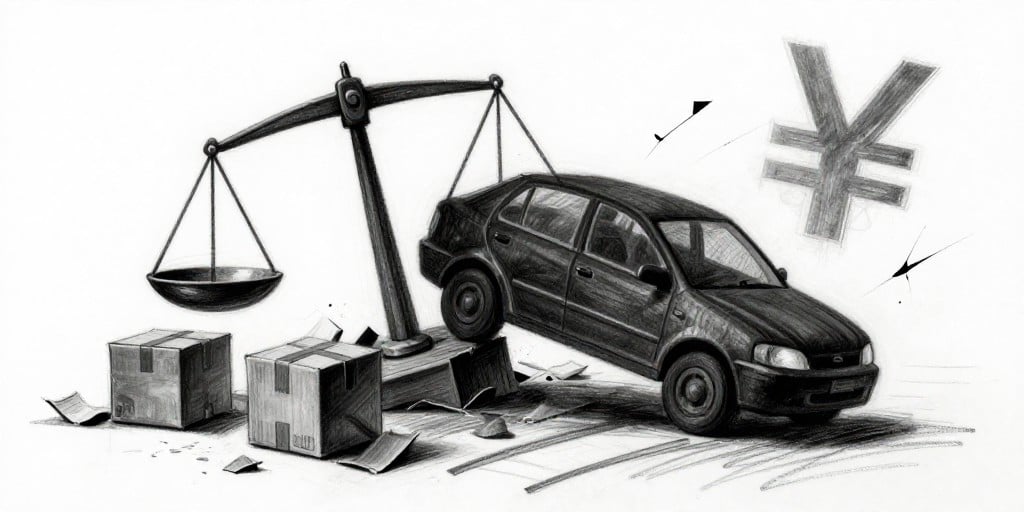
2026 Half‑Year Performance of Chang’an Automobile
A Profound Decline in Profitability
Chang’an Automobile’s latest half‑year report reveals a dramatic 64.3 % drop in net profit, falling from an implied pre‑adjustment figure of roughly 12 billion CNY to only 8.17 billion CNY. The company’s revenue, meanwhile, slid 9.7 % year‑on‑year to 656.34 billion CNY. This contraction is not merely a matter of slower sales; it is the cumulative outcome of three interlocking forces that the management team has failed to neutralise.
Exchange‑rate volatility The report exposes a staggering reversal in financial‑expense treatment: from a net benefit of –19.57 billion CNY in the previous period to a net cost of 0.69 billion CNY. The exchange‑rate loss of 2.30 billion CNY eclipses the 13.56 billion CNY gain recorded a year earlier, creating a swing of 15.86 billion CNY. This is the “key variable” that the company itself acknowledges as the “most significant drag” on its earnings. Yet, the answer offered—establishing an FX research team and a forward‑trade risk‑control mechanism—appears to be an after‑thought rather than a pre‑emptive safeguard.
Inventory write‑down In a move that speaks volumes about the underlying health of its production pipeline, Chang’an booked a 4.56 billion CNY provision for impaired assets. Inventory alone accounts for 4.68 billion CNY of this figure, effectively erasing a sizeable chunk of the company’s gross margin. The write‑down is justified by the continued contraction in the internal‑combustion vehicle market, a trend that is only accelerated by the rapid rise of new‑energy vehicles, which now enjoy a retail penetration rate surpassing 65 % in China. Had this provision not been made, the company’s net profit would have exceeded 12 billion CNY, illustrating the depth of the shock.
Operational inefficiencies Beyond macro‑economic pressures, the report signals that sales volumes have dropped, yet the company has not deployed a decisive response. The narrative that “sales decline and reduced foreign‑exchange gains” are the primary culprits is self‑serving. It deflects scrutiny from more fundamental issues such as product mix, pricing strategy, and distribution channel performance—areas where the company’s current trajectory is clearly unsustainable.
Management’s Response: A Tenuous Plan
Chang’an’s announcement that it will “focus on the exchange‑rate market, strengthen research, and set up an FX risk‑control team” is a textbook example of damage control. The company has not provided any concrete metrics or timelines to demonstrate how these new structures will offset the 15.86 billion CNY swing. Similarly, the stated ambition to evolve from “product export” to “system export” through overseas manufacturing and technology collaboration lacks specificity. Investors are left questioning whether this is a genuine strategic pivot or a rebranding exercise designed to placate market sentiment.
Market Context and Competitive Landscape
The broader automotive sector paints a mixed picture. In the same reporting week, major peers delivered divergent outcomes: BYD and SAIC reported moderate profit declines, while GAC posted a widening loss, and SAIC’s core profitability surged by 72 %. Chang’an’s 64 % plunge starkly contrasts with SAIC’s resilient performance, underscoring the company’s failure to adapt to the accelerating shift toward electric vehicles and to manage the inevitable inventory write‑downs that accompany such a transition.
Investor Implications
Given Chang’an’s market cap of 8.79 billion CNY and a P/E ratio of 22.9, the current earnings slump erodes shareholder value dramatically. The company’s stock price, hovering around 7.1 CNY, sits well below its 52‑week low of 6.66 CNY and far short of the 13.84 CNY peak reached in October 2025. Without a robust corrective framework, the stock’s trajectory is likely to remain on a downward slope, further diminishing the company’s ability to raise capital for necessary R&D and capital expenditures.
Conclusion
Chang’an Automobile’s latest financial disclosure is not merely a report of declining numbers—it is a stark indictment of strategic mismanagement and reactive governance. Exchange‑rate exposure, inventory misallocation, and a lackluster sales response converge to deliver a profit collapse that cannot be justified by market conditions alone. The company’s future hinges on whether it can transform its reactive measures into a proactive, data‑driven strategy that realigns production with the burgeoning new‑energy vehicle demand. Until such transformation materialises, investors and stakeholders should regard Chang’an’s performance with heightened skepticism and demand concrete, measurable actions that reverse the current downward spiral.