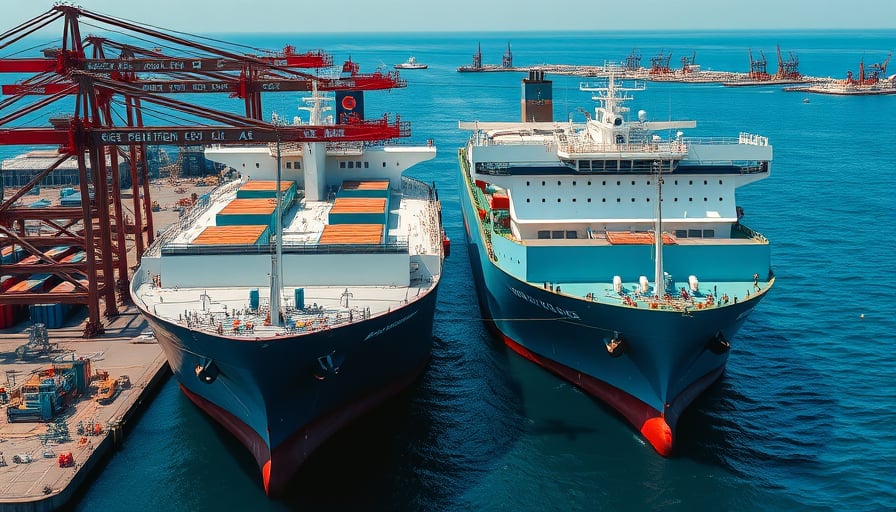
China Merchants Energy Shipping: A Strategic Surge in a Bullish Market
China Merchants Energy Shipping (CMES, 601872.SS) has once again placed itself at the centre of China’s energy‑transportation narrative. With a market cap of ¥132.5 billion and a 52‑week high of ¥19.65 (trading near ¥16.36 on 2026‑03‑30), the company is riding a wave of bullish sentiment that swept the Shanghai Stock Exchange on 1 April 2026.
The stock’s recent 20 % daily limit‑up—the highest in the market’s daily range—coincided with a 3‑day rally in the shipping sector. CMES’s own fleet‑expansion plans have supplied the catalysts that investors were looking for, while the broader macro‑environment of an escalating global oil trade has amplified the story.
1. Fleet Expansion: 10 New VLCCs
On 30 March, CMES disclosed that it had signed 10 ship‑building agreements with Dalian Shipbuilding Industry Co (DSIC) and its wholly‑owned subsidiary, Haihong Shipbuilding (Hong Kong) Ltd. The contracts, valued at roughly ¥8.566 billion (≈US$1.2 billion), cover very‑large crude carriers (VLCCs) equipped with desulfurization towers and shaft‑drive generators. These vessels will enter service between 2028 and 2030, adding significant cargo capacity to CMES’s fleet at a time when oil demand is projected to rise sharply due to geopolitical tensions in the Middle East.
This move is not merely a capital‑intensive expansion; it is a strategic bet on the resilience of oil shipping in an era where traditional oil tankers face increasing regulatory and environmental scrutiny. By equipping its new ships with desulfurization technology, CMES is positioning itself to meet stricter IMO 2020 sulfur limits and the upcoming IMO 2025 and 2030 mandates.
2. Market Context: A Surge in the Shipping Sector
The Shanghai market’s collective rally on 1 April—indices up over 1 %, the Shanghai Composite at +1.36 % and the ChiNext at +1.18 %—was driven largely by the shipping sector’s breakout. While tech and pharma were the headline drivers, the shipping cluster, led by CMES and peers such as 招商轮船 and 锦江航运, posted double‑digit gains and several limit‑up stocks.
- 沪深北三市 reported a ¥133.57 billion turnover in the first half‑day, barely lower than the previous day, indicating sustained investor appetite.
- The Shanghai Shipping Index surged, with 招商轮船 and 锦江航运 both hitting their daily limit‑ups.
- According to a 27 March report from Clarksons, the Clarksons Shipping Index rose 9.3 % month‑on‑month to $49,141 /day, a reflection of the buoyant freight rates in the oil tanker market.
The market’s enthusiasm for shipping is not arbitrary. It is rooted in the geopolitical volatility that has kept crude oil prices above $80 per barrel, thereby sustaining high freight rates. Investors are recognizing that CMES, with its expanded VLCC orderbook, is well‑positioned to capture the upside from these higher rates.
3. Financial Metrics: A Strong Valuation Narrative
With a Price‑to‑Earnings ratio of 23.01, CMES is trading at a premium to the sector average, yet the premium is justified by its fleet growth and order pipeline. The company’s close price of ¥16.36 represents a 7.9 % decline from its 52‑week high, offering a margin of safety for momentum traders.
The recent limit‑up demonstrates a robust demand‑supply imbalance: the number of shares available for trading remains constrained, while the number of buyers is surging. This imbalance is a classic indicator of a short‑term rally that may not be sustained without further fundamental support.
4. Risks and Counter‑Arguments
- Capital Expenditure Risk – The ¥85.66 billion total cost for the 10 VLCCs will require significant financing. Should interest rates climb, CMES’s debt servicing costs could erode margins.
- Market Over‑valuation – The PE of 23.01 may be unsustainable if freight rates decline. A sudden drop in crude oil prices or a shift towards low‑carbon shipping could reduce demand for oil tankers.
- Regulatory Pressure – While desulfurization towers address current IMO limits, future regulations on methane emissions and CO₂ could necessitate further retrofits, adding cost.
Despite these concerns, the current market environment—high freight rates, geopolitical instability, and CMES’s proactive fleet strategy—creates a favorable risk‑rewards profile for investors willing to ride the wave.
5. Conclusion
China Merchants Energy Shipping has leveraged a strategic fleet expansion to ride the crest of a market rally that is simultaneously buoyed by global oil demand and shipping sector enthusiasm. Its aggressive order book, coupled with an expanding fleet, positions it to benefit from sustained high freight rates, while its valuation, though elevated, reflects the market’s confidence in its long‑term prospects.
For market participants, CMES exemplifies a high‑growth, high‑risk play that could deliver substantial upside if oil freight rates remain robust. Those who choose to enter the market should remain vigilant for any signs of rate deterioration or financing constraints that could erode the current premium.