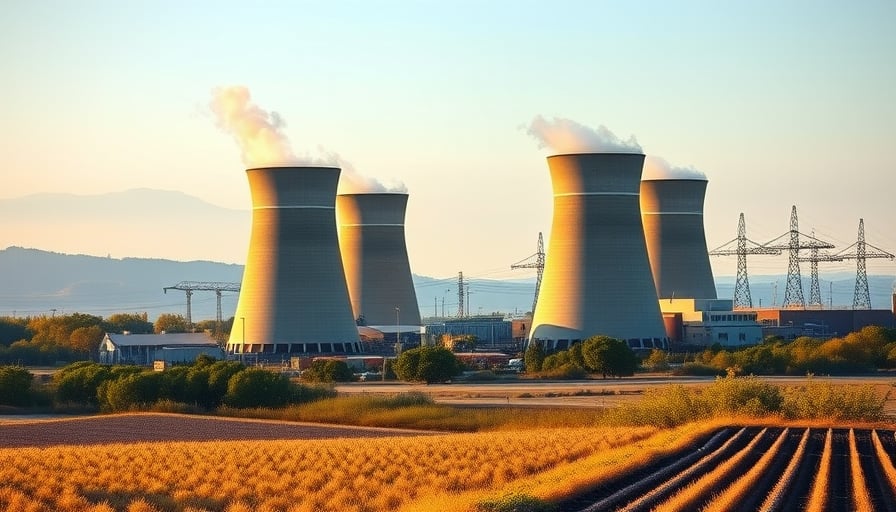
China National Nuclear Power Co. Ltd: Navigating a Rapidly Expanding Energy Landscape
China National Nuclear Power Co. Ltd. (CNPC), a Shanghai‑listed utility company with a market capitalization of approximately 184 billion CNY, has positioned itself at the intersection of China’s national energy strategy and the global transition toward cleaner power sources. On the day the company’s stock closed at 8.95 CNY, its share price hovered near the lower end of a 52‑week range that peaked at 9.85 CNY in July and dipped to 8.37 CNY in September. Analysts noted that CNPC’s price‑earnings ratio of 23.11 places the firm above the sector average, reflecting investors’ confidence in its long‑term prospects.
A Booming Global Nuclear Market
The most immediate backdrop to CNPC’s performance is the rapid expansion of the worldwide nuclear power market. A recent market‑research briefing released on 2 April 2026 by Coherent Market Insights projects the global nuclear power market to grow from USD 38.30 billion in 2026 to USD 51.43 billion by 2033—a compound annual growth rate of 4.3%. The report highlights a steady increase in demand, driven by the need for low‑carbon electricity, technological advancements, and supportive policy frameworks.
This macro‑environment is particularly favorable for CNPC, which is responsible for the construction, management, and operation of nuclear reactors across China. The company’s focus on nuclear power—an energy source that offers high capacity factor and reliable baseload output—aligns with the national goal of achieving a more secure and diversified energy mix. As China continues to commit to carbon neutrality by 2060, nuclear power is expected to play a pivotal role in meeting the country’s decarbonisation targets.
Domestic Policy Momentum and Green‑Power Synergies
In parallel, the Chinese government’s recent policy directives reinforce the growth trajectory of clean energy. During a provincial tour in Sichuan, Premier Li Qiang underscored the importance of expanding green‑electricity supply and accelerating the construction of new‑generation power grids. He emphasized that the integration of renewable resources—solar, wind, hydro, and biomass—must be complemented by robust grid infrastructure capable of accommodating the intermittency of these sources.
These policy signals dovetail with CNPC’s operational focus. While the company is primarily engaged in nuclear power, its portfolio benefits indirectly from the broader green‑energy ecosystem. The promotion of high‑capacity, low‑carbon nuclear plants enhances grid stability, reducing the need for backup fossil‑fuel power and thereby complementing renewable projects. Moreover, the Chinese Energy Administration’s encouragement of “AI‑driven” and data‑centric approaches to energy management creates opportunities for CNPC to leverage advanced analytics and digital twins in plant operations, improving efficiency and safety.
Share Buyback Initiative
On 1 April 2026, CNPC announced a share‑buyback programme, as reported on the Xueqiu platform. While the exact fiscal details remain undisclosed, such a move typically signals confidence in the company’s intrinsic value and provides a cushion against market volatility. Share repurchases can also enhance earnings per share, potentially supporting a higher price‑earnings ratio in the future. Investors will watch for the programme’s scope—whether it covers a fixed amount of capital or a specific number of shares—and the timeline over which the buyback will occur.
Market Implications and Forward Outlook
CNPC’s recent developments come at a time when the Chinese utilities sector is undergoing significant transformation. The firm’s 52‑week high of 9.85 CNY, coupled with a steady closing price of 8.95 CNY, suggests that the market is cautiously optimistic. Analysts project that the company’s revenue will continue to rise as new nuclear projects enter commercial operation, while existing plants achieve higher capacity utilisation rates.
Key factors that may influence CNPC’s trajectory include:
- Regulatory Stability – Ongoing government support for nuclear safety and expansion will be crucial. Any shift in policy could alter construction timelines and capital allocation.
- Technological Innovation – Advances in reactor design, such as small modular reactors (SMRs), could accelerate deployment and lower costs, offering CNPC a competitive edge.
- Grid Modernisation – The expansion of high‑voltage transmission networks and the integration of AI for grid management will enhance nuclear plants’ flexibility and reliability.
- Global Supply Chain Dynamics – Geopolitical tensions and the global shift toward “energy security” may affect the availability and cost of critical materials and equipment.
In sum, China National Nuclear Power Co. Ltd. is positioned to benefit from both the domestic push toward green energy and the projected global expansion of nuclear power. The company’s share‑buyback initiative signals managerial confidence, while its alignment with national energy policy and emerging technologies positions it well for sustained growth in an era of decarbonisation and digital transformation.