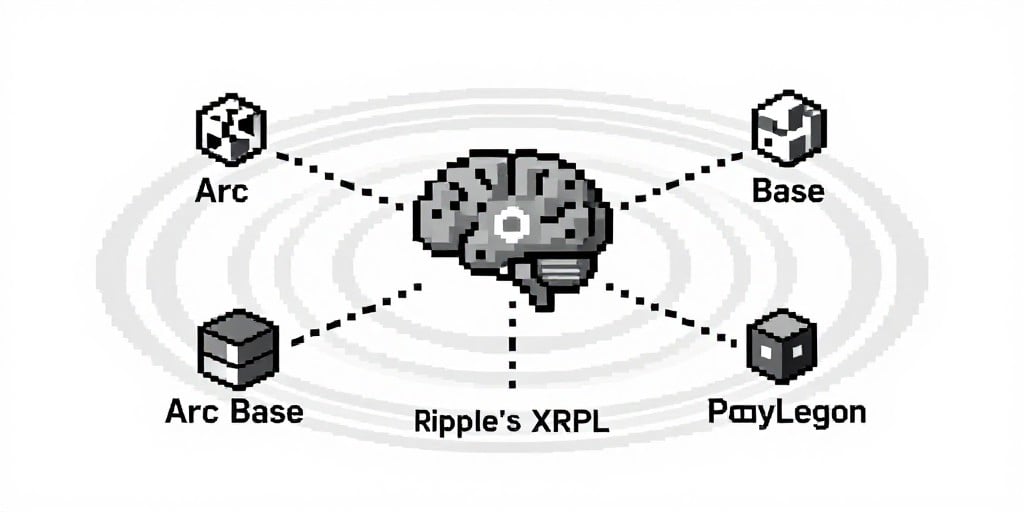
Circle launches x402 Facilitator Service on Arc, expanding support to Base and Polygon PoS
Circle’s strategic rollout of its x402 Facilitator Service marks a decisive move toward centralizing digital payment infrastructure. By enabling the service on the Arc platform and extending compatibility to Base and Polygon PoS, Circle positions itself as the de facto gatekeeper for automated transactions across multiple layer‑2 networks. The announcement, made on 16 September 2026, signals a shift in the crypto‑payments ecosystem: instead of a fragmented web of independent protocols, a single corporate entity could now orchestrate the majority of AI‑driven micro‑transactions. This consolidation raises legitimate concerns about system resilience and the concentration of economic power in the hands of a few.
Ripple’s aggressive push into AI payment standards
On 17 September, Ripple announced the addition of XRP payments to Stripe and Coinbase’s x402 AI standard in a new developer kit. The move underscores Ripple’s intent to embed the XRP Ledger (XRPL) into the next wave of AI‑mediated commerce. By supporting both x402 and the Machine Payments Protocol (MPP), Ripple is ensuring that AI agents can transact seamlessly with XRP and its stablecoin RLUSD. Ripple’s developer kit now enables AI agents to request data, compute, or other digital services and pay for them within three to five seconds, with costs under one cent—a performance benchmark that could outpace traditional payment networks.
XRP’s role in the forthcoming AI agent economy
The German‑language coverage on 18 September by bitcoin2go.de highlights the XRPL’s expanding utility. Ripple’s Machine Payments Protocol allows AI agents to autonomously procure digital services and pay directly with XRP, effectively turning the token into the currency of choice for AI‑driven commerce. XRPL already supports multiple AI standards, including x402 and the Open Wallet Standard, reinforcing its versatility. This rapid adoption suggests that XRPL could become the backbone of a burgeoning AI‑agent economy, where micro‑payments for data and computation are executed at scale.
B.AI’s record‑breaking throughput underscores the need for robust settlement layers
Coincidentally, on the same day, B.AI reported an unprecedented daily throughput of 1.51 trillion tokens—an increase of 71,500 × since launch. B.AI’s integration of compute routing, decentralized settlement, and full‑stack agent infrastructure illustrates the demand for high‑capacity settlement layers that can keep pace with AI traffic. If XRPL or Circle’s x402 infrastructure cannot match such performance, they risk being eclipsed by more efficient competitors.
Agentic‑payment data confirms momentum
CoinGape’s analysis on 17 September documents that agent‑driven payment activity through x402 and MPP has already surpassed two million transactions in late August and early September. The volume trajectory suggests that the market is moving from experimental to mainstream adoption. As AI agents become routine actors in commerce, the need for reliable, low‑latency settlement becomes urgent. Circle’s centralization strategy could either satisfy this need or stifle innovation, depending on execution.
Conclusion: A pivotal juncture for the crypto‑payments landscape
The simultaneous advancements by Circle, Ripple, and B.AI signal a turning point: AI agents are no longer theoretical constructs but active participants demanding instant, inexpensive, and programmable payment mechanisms. While Circle’s Facilitator Service and Ripple’s XRPL integration offer compelling solutions, they also concentrate control and introduce single points of failure. Stakeholders must vigilantly monitor the balance between performance gains and the risks of centralization. The next few weeks will reveal whether the crypto‑payments ecosystem can scale to meet the demands of an AI‑driven economy without compromising decentralization principles.