
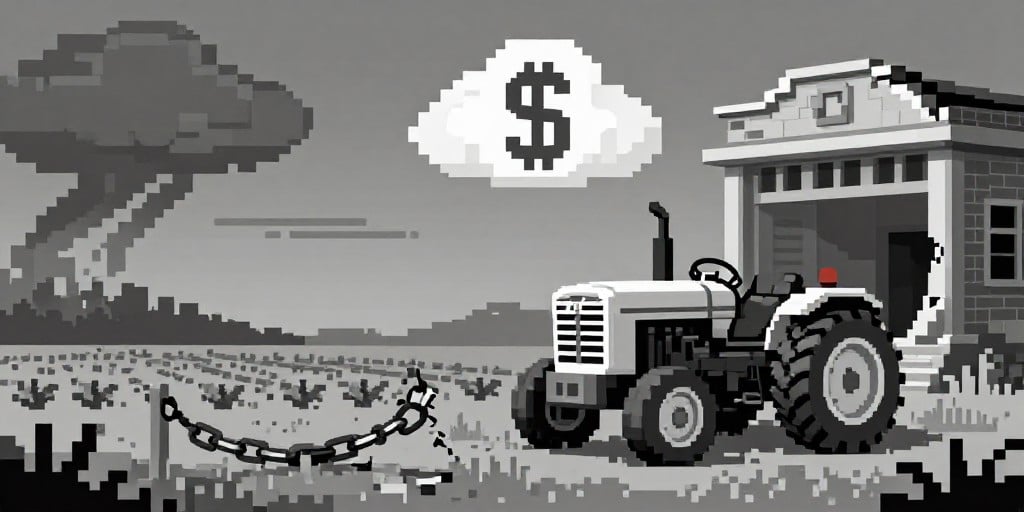
Deere & Co. Faces a Mounting Credit Crunch in the U.S. Agricultural Sector
The United States agricultural market is spiraling into a credit crisis that threatens Deere & Co.’s core customer base. According to a recent report from finanznachrichten.de dated 08 August 2026, American farmers are already grappling with falling commodity prices, soaring input costs, and weak export prospects. The situation has escalated further as banks and other financiers tighten lending standards, demanding higher collateral and subjecting new credit applications to rigorous scrutiny. This tightening of credit conditions is not merely a warning; it signals a structural shift in the agricultural sector that could ripple across the entire machinery supply chain.
The Credit Conundrum and Its Immediate Impact on Deere
Deere & Co., the world’s leading manufacturer of agricultural, construction, forestry, and commercial equipment, relies heavily on farm‑owned equipment to generate a steady stream of sales and recurring revenue from replacement parts and financing services. The company’s business model is intrinsically tied to farmers’ ability to acquire capital for new machinery and to service existing debt. As banks demand tighter covenants, farmers are forced to allocate more capital toward collateral rather than new equipment purchases. This dynamic directly translates into a slowdown in Deere’s top‑line growth.
The report cites a staggering $600 billion in agricultural loans that are now under heightened scrutiny. For Deere, this translates into a compressed demand curve: fewer farmers can afford new tractors, harvesters, or sprayers. The company’s flagship product lines, which include the iconic 8R and 9R series tractors, are experiencing a decline in order volume, especially in regions where commodity prices remain depressed.
Deere’s Financial Position in the Face of the Crisis
With a market capitalization of $169 billion and a price‑earnings ratio of 34.68, Deere’s valuation already reflects optimism about long‑term growth. However, the current environment erodes that optimism. The company’s close price of $620.83 on 06 August 2026 sits below the 52‑week high of $674.19 (18 February 2026) but well above the 52‑week low of $433 (13 October 2025), indicating volatility that investors are keen to monitor.
Deere’s strength lies in its diversified product portfolio and global footprint, yet the company’s dependence on the U.S. farm sector is a vulnerability. The credit tightening threatens not only sales of new equipment but also the financing of existing inventories and parts. Deere’s financing arm, which offers product and parts financing services, may see a contraction in loan volumes and an increase in default risk.
Strategic Responses and Risks
Diversification into Emerging Markets Deere can accelerate penetration in emerging economies where credit markets remain more accommodative. However, this shift requires significant capital and localized supply chains, which could dilute focus from core U.S. operations.
Product Innovation and Cost Reduction Introducing high‑efficiency, lower‑cost machinery could appeal to price‑sensitive farmers. Yet, R&D investment is capital‑intensive and the return on such innovation can be delayed, especially in a tightening credit environment.
Strengthening the Financing Arm Deere may tighten its own financing terms, offering higher interest rates or requiring more collateral. While this could safeguard revenue, it risks alienating customers who are already struggling to secure external credit.
Risk Management and Hedging The company could employ sophisticated hedging strategies to mitigate commodity price volatility, but this adds complexity and may not fully offset the loss of new equipment orders.
Conclusion
Deere & Co. stands at a crossroads. The unfolding credit crisis in the U.S. agricultural sector threatens to erode a critical source of demand. While the company’s robust fundamentals and diversified product line provide a buffer, the immediate risk to sales and financing streams is significant. Investors and stakeholders must scrutinize Deere’s strategic initiatives and assess whether the company’s actions will suffice to navigate the tightening credit landscape or whether the looming downturn will erode shareholder value.