
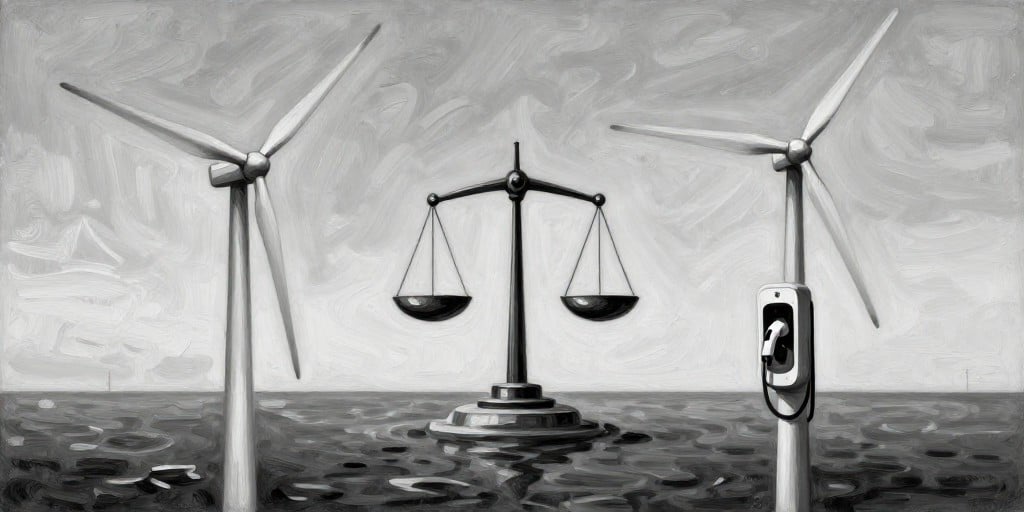
EnBW’s Strategic Reassessment of Offshore Wind and Consumer‑Facing Energy Services
The German power producer EnBW Energie Baden‑Württemberg AG is recalibrating its offshore wind ambitions in light of escalating costs and supply‑chain bottlenecks, while simultaneously tightening its consumer‑energy offering to maintain competitive pricing and market share.
1. Offshore Wind: From Ambition to Pragmatism
In a candid address to the FAZ and Finanznachrichten on 8 July 2026, EnBW’s Chairman, Georg Stamatelopoulos, highlighted a “dramatically worsened” situation in the offshore sector. The company’s portfolio—comprising Baltic I, Baltic II, Hohe See and Albatros, and the forthcoming He Dreiht 960 MW park—has already achieved 55 of its 64 turbines, with roughly 30 operational. Yet, the escalating price of wind turbines, logistics, and cabling has surged 30‑40 % over five years and more than 50 % over fifteen years. In response, Stamatelopoulos proposes a temporary reduction of the national offshore target to 55 GW from the previously planned 64 GW, arguing that a 20‑year‑old plan cannot ignore current realities.
The German federal government remains committed to a 70 GW offshore wind milestone by 2045. EnBW’s recalibration, however, is not a withdrawal but a “sensible correction”, according to Stamatelopoulos. He calls for a five‑year compensation waiver of 200 hours for wind and solar operators, a measure that could ease the financial burden while preserving long‑term investment returns. The company’s stance is framed as a “long‑term project” that must adapt to changing economics without compromising the broader energy‑transition agenda.
2. Consumer‑Centric Pricing: Summer Promotions and Reduced EV‑Charging Costs
While the offshore strategy undergoes a reality check, EnBW is simultaneously engaging its retail base with aggressive price actions:
| Date | Source | Action |
|---|---|---|
| 7 July 2026 | stadt‑bremerhaven.de | “Günstiger laden an eigenen Stationen im Sommer.” |
| 7 July 2026 | ecomento.de | Launch of a summer‑price campaign for charging at EnBW’s own stations. |
| 7 July 2026 | mobiflip.de | Reduction of electric‑vehicle charging prices through September. |
These coordinated initiatives underscore EnBW’s dual focus: maintaining market relevance among residential and commercial customers while navigating the high‑cost environment of renewable expansion.
3. Financial Context
- Market Cap: €22.7 bn
- Close Price (06 July 2026): €71.20
- 52‑Week High/Low: €74.80 / €63.00
- P/E Ratio: –32.95 (indicative of earnings below zero, a common feature in capital‑intensive utilities investing heavily in renewables)
The negative P/E reflects the ongoing capital outlay required for offshore wind and the transitional costs associated with moving away from conventional generation. Nevertheless, the company’s valuation remains anchored by a robust asset base and diversified service portfolio that includes electricity, gas, and environmental solutions.
4. Outlook
EnBW’s revised offshore target—while signaling caution—does not negate its commitment to renewable expansion. The company is likely to prioritize cost‑efficient, high‑yield projects and pursue technological innovations (e.g., advanced turbine designs, logistics optimization) to bring future offshore wind economics back in line with national goals. Simultaneously, the consumer‑centric pricing strategy should buffer the company against market volatility and enhance brand loyalty during a period of supply‑chain strain.
In sum, EnBW is balancing strategic prudence in capital allocation with market‑driven consumer initiatives. The company’s ability to navigate these dual imperatives will shape its trajectory in Germany’s evolving energy landscape over the coming decade.