
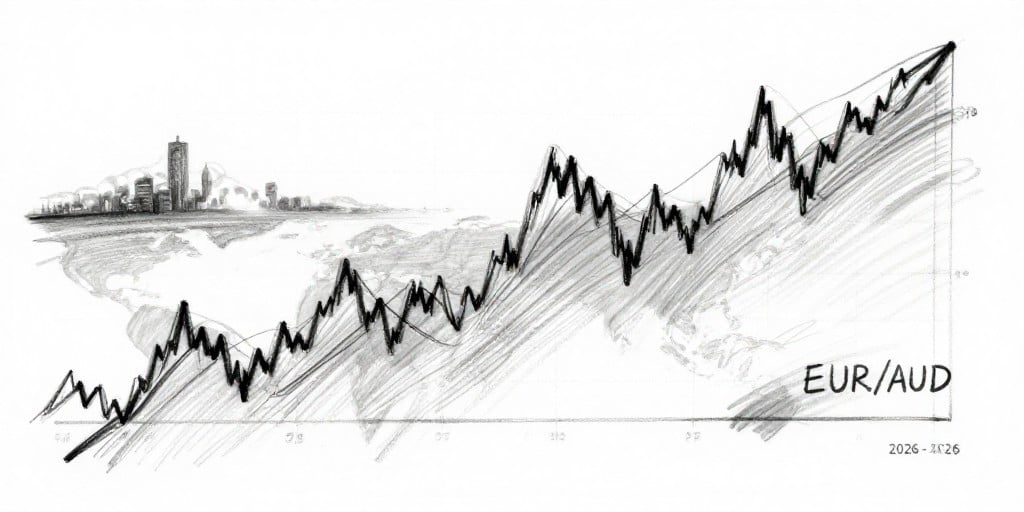
In the ever-evolving landscape of the foreign exchange market, the Euro/Australian Dollar (EUR/AUD) pair has recently captured the attention of traders and analysts alike. As of May 19, 2026, the closing price for this currency pair stood at 1.63368, reflecting a dynamic interplay of economic factors and market sentiment. This figure is particularly noteworthy when juxtaposed against the 52-week high of 1.81576, recorded on October 16, 2025, and the 52-week low of 1.61114, observed on May 12, 2026.
The recent fluctuations in the EUR/AUD exchange rate can be attributed to a confluence of economic indicators and geopolitical developments. The 52-week high of 1.81576 marked a period of relative strength for the Euro, buoyed by robust economic data from the Eurozone and a favorable interest rate outlook from the European Central Bank. Conversely, the Australian Dollar faced headwinds from subdued commodity prices and cautious monetary policy from the Reserve Bank of Australia, which contributed to the currency’s depreciation during this period.
As the year progressed, the EUR/AUD pair experienced a downward trajectory, culminating in the 52-week low of 1.61114. This decline was driven by a resurgence in the Australian Dollar, fueled by a rebound in commodity prices, particularly iron ore and coal, which are pivotal to Australia’s export economy. Additionally, the Reserve Bank of Australia’s hawkish stance on interest rates provided further impetus to the AUD, as investors sought higher yields in a low-interest-rate environment.
The closing price of 1.63368 on May 19, 2026, represents a midpoint between the 52-week extremes, suggesting a period of consolidation and recalibration for the EUR/AUD pair. Traders and analysts are closely monitoring the economic outlook of both the Eurozone and Australia, as well as global geopolitical developments, to gauge the potential direction of this currency pair.
In the Eurozone, economic recovery remains a focal point, with inflationary pressures and labor market dynamics playing crucial roles in shaping monetary policy decisions. The European Central Bank’s approach to interest rates and quantitative easing will be pivotal in determining the Euro’s trajectory. Meanwhile, in Australia, the economic landscape is influenced by trade relations, particularly with key partners such as China, and domestic fiscal policies aimed at stimulating growth.
As the EUR/AUD pair navigates this complex terrain, market participants are advised to remain vigilant, considering both macroeconomic indicators and geopolitical events that could sway currency valuations. The interplay between the Euro and the Australian Dollar continues to offer a fascinating glimpse into the broader dynamics of the global economy, underscoring the importance of informed analysis and strategic foresight in the realm of foreign exchange trading.