
Gazprom PJSC, a leading entity in the Russian energy sector, has recently faced significant operational challenges due to geopolitical tensions. As a major player in the oil, gas, and consumable fuels industry, Gazprom’s operations span across gas pipeline systems, gas production and exploration, and oil production and refining, primarily within the Russian Federation and extending into European countries. The company also engages in gas storage and the generation of electric and heat energy.
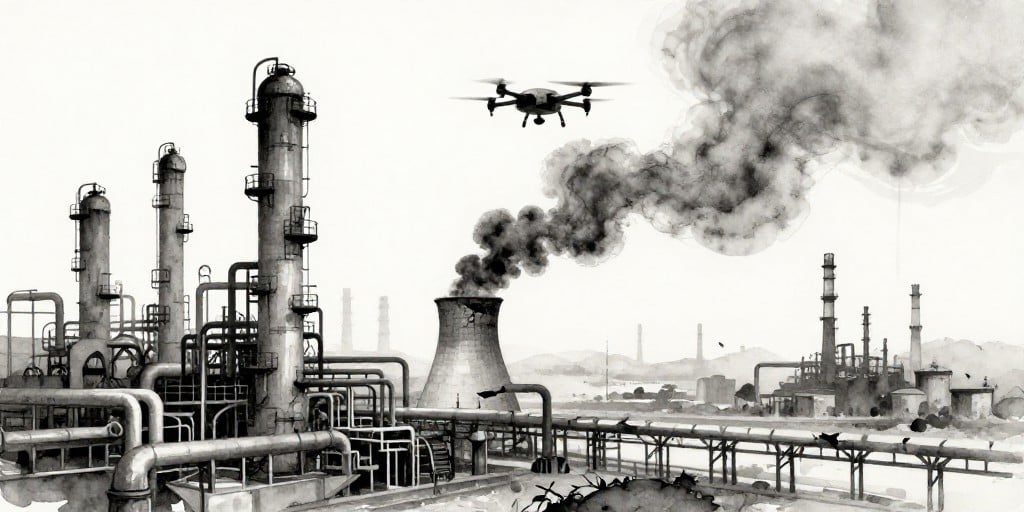
The recent escalation in hostilities has seen Ukraine targeting Russian oil infrastructure, with Gazprom PJSC’s Neftekhim Salavat facility near the Urals being struck by drone fire. Despite the severity of the attack, emergency services were able to contain the blaze, allowing for a swift resumption of normal production activities. This incident is part of a broader pattern of Ukrainian strikes on Russian refineries and shipping routes in the Black Sea and Sea of Azov. These attacks have significantly reduced refining runs to their lowest levels in over two decades, exerting additional pressure on global fuel markets.
Gazprom PJSC, while not commenting on the specific incident, finds itself at the epicenter of these ongoing conflicts, which have direct implications for its refinery output and supply chain stability. The company’s strategic importance in the Russian energy sector makes it a focal point in the broader geopolitical landscape, influencing both regional and global energy dynamics.
Financially, Gazprom PJSC is listed on the Moscow Stock Exchange, with a market capitalization of 2.13 trillion RUB. As of July 4, 2026, the company’s close price stood at 97.84 RUB, with a 52-week high of 142.53 RUB recorded on August 14, 2025, and a low of 95.65 RUB on June 25, 2026. The price-to-earnings ratio of 1.72 reflects the market’s valuation of the company amidst these challenging circumstances.
The ongoing conflict and its impact on Gazprom PJSC underscore the vulnerability of energy infrastructure to geopolitical tensions. As the situation evolves, the company’s ability to navigate these challenges will be crucial in maintaining its operational integrity and market position. The broader implications for the global energy market remain a point of concern, with potential ripple effects on supply chains and fuel prices worldwide.