
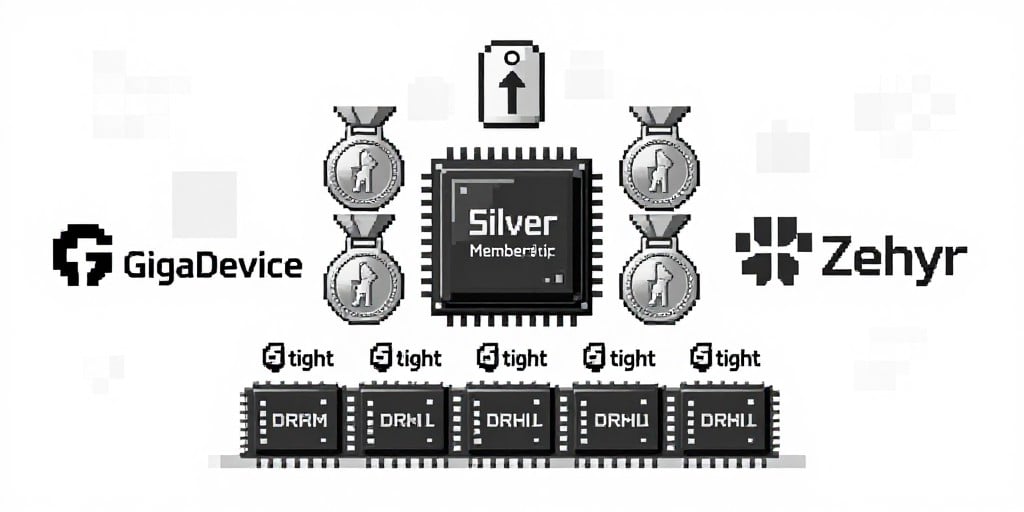
GigaDevice Semiconductor Inc. Expands Its Ecosystem Footprint and Navigates a Tight DRAM Market
GigaDevice Semiconductor Inc. (ticker: 03986.HK) announced a strategic partnership with the Zephyr Project, a leading open‑source real‑time operating system (RTOS) managed by the Linux Foundation, on September 3, 2026. The company was welcomed as a Silver Member, granting it a formal status within both the Zephyr community and the Linux Foundation. This move is expected to enhance the integration of GigaDevice’s GD32‑MCU portfolio with open‑source software stacks, potentially broadening the appeal of its 32‑bit microcontrollers, flash memory products, and sensor solutions to developers seeking flexible, community‑driven platforms.
Zephyr Partnership Signals a Software‑First Strategy
While GigaDevice has long focused on non‑volatile memory devices—flash chips, memory cards, and integrated circuits—the Zephyr affiliation marks a deliberate push toward software‑centric ecosystems. By aligning its hardware with a widely adopted RTOS, the firm positions itself to offer end‑to‑end solutions for embedded systems ranging from Internet‑of‑Things (IoT) devices to industrial automation. The “Silver Member” designation also affords GigaDevice access to collaborative development resources, joint marketing initiatives, and an expanded developer community that can accelerate time‑to‑market for new products.
Tight DRAM Supply Persists, But Prices Remain Elevated
Shortly after the Zephyr announcement, GigaDevice’s senior management reiterated that the DRAM market will likely remain constrained into the next fiscal year. Vice Chairman and General Manager He Wei, speaking at an earnings briefing on September 2, 2026, noted that while DRAM prices are expected to trend upward moderately in the second half of 2026, incremental capacity expansion is projected to stay limited. Consequently, the “tight DRAM supply” scenario is unlikely to ease noticeably, and the industry upcycle may extend longer than previously anticipated.
This outlook aligns with broader market observations: the A‑share indices experienced modest declines on September 2, as defense stocks rallied and broader market sentiment remained cautious. Currency movements also played a role, with the Chinese renminbi’s central parity rate against the U.S. dollar set at 6.7829, reflecting a 19‑basis‑point depreciation from the prior day.
Franchise Agreement with Rutronik Expands Distribution Reach
On August 31, GigaDevice entered into a franchise agreement with German distributor Rutronik. The partnership will allow Rutronik to market and support GigaDevice’s embedded technologies across European and Asian markets. By leveraging Rutronik’s established distribution network, GigaDevice can accelerate penetration of its flash and MCU products into new verticals such as automotive electronics, smart home devices, and industrial control systems.
Market Position and Financial Snapshot
As of August 31, GigaDevice’s closing share price stood at HK$475.40, positioned below its 52‑week high of HK$1,248 and above its low of HK$220. With a market capitalization of approximately HK$332.7 billion and a price‑earnings ratio of 34.96, the company trades at a premium that reflects investor expectations for sustained growth in its memory and embedded solutions segment. The firm’s operations are headquartered in Beijing, and it continues to serve a global customer base through both direct sales and partner channels.
Outlook
The combination of a high‑profile open‑source partnership, a confirmed franchise agreement, and a clear supply‑side assessment of the DRAM market provides a balanced narrative for GigaDevice’s near‑term trajectory. While the DRAM supply bottleneck may limit short‑term revenue growth, the strategic alignment with Zephyr and Rutronik positions the company to capture expanding demand for low‑power, high‑performance embedded solutions. Investors will likely watch closely how GigaDevice translates its hardware strengths into software‑enabled ecosystems and whether the company can sustain its valuation multiples amid ongoing market volatility.