
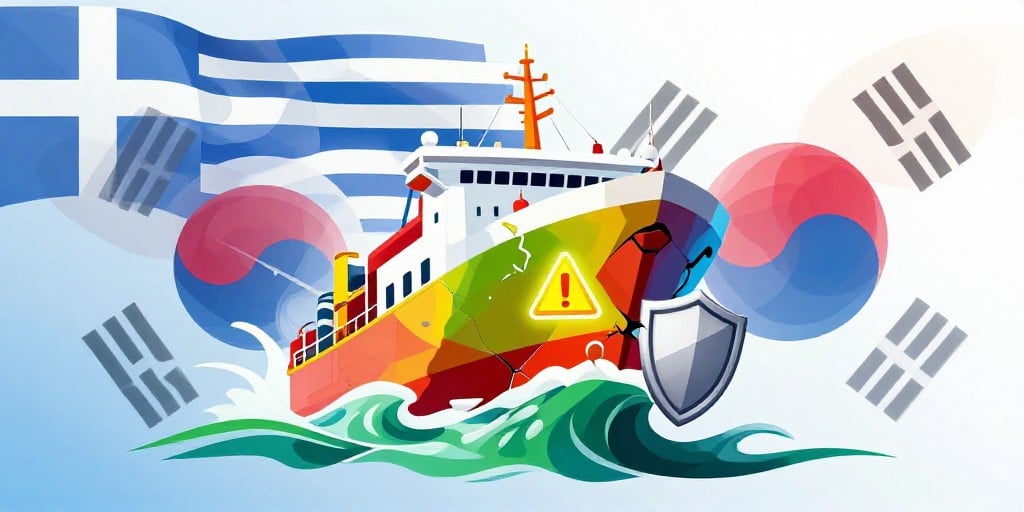
Recent Developments at HD Hyundai Heavy Industries
The South‑Korean shipbuilding and heavy‑machinery conglomerate, HD Hyundai Heavy Industries (HSX: 329180.KS), has experienced a mix of operational setbacks and strategic opportunities in the past few days. While the company’s share price slipped 7.3 % to 4,48 500 KRW after a fatal accident at one of its outsourcing docks, new bilateral agreements with Greece are poised to strengthen the firm’s position in the global maritime arena.
1. Industrial Accident and Immediate Aftermath
On 19 July, a worker at the Busan Dongbu Branch of the Busan Regional Office of Employment and Labor was fatally caught between a gondola and an upper platform at an outsourcing dock in the Shipbuilding Business Unit. The incident triggered a partial work‑suspension order from the Busan Regional Office. The Korean Ministry of Employment and Labor, together with local police, has launched an investigation. While the exact cause remains under scrutiny, the accident underscores the persistent safety challenges inherent in ship‑building operations—a sector that routinely grapples with high‑risk construction activities and complex logistics.
The incident has already impacted the market perception of the company. Shares fell from the 52‑week high of 765 000 KRW to 4,48 500 KRW, a decline of 7.33 %. Investors have responded cautiously, weighing the reputational risk against HD Hyundai’s robust fundamentals, including a market cap of approximately 5.08 × 10¹³ KRW and a price‑to‑earnings ratio of 24.37.
2. Strategic Maritime Partnerships with Greece
In a parallel development, Greek Foreign Minister George Gerapetritis highlighted a renewed focus on maritime cooperation during a recent visit to Seoul. Greece, the world’s leading ship‑owning nation, and Korea, a global powerhouse in shipbuilding, have long shared a strong bilateral relationship. The two countries are now looking beyond traditional trade to joint ventures in green growth, digital governance, innovation, and regional security.
A key element of this partnership is the collaboration between Skaramangas Shipyard and HD Hyundai Heavy Industries on naval and coast‑guard vessel projects. Moreover, a trilateral investment program—Project Trident—has been initiated, involving Greek, Korean, and United States stakeholders. The project, valued at 1.35 billion € (approximately 1.58 billion USD), is expected to accelerate the development of next‑generation maritime vessels that meet stringent environmental and safety standards.
For HD Hyundai, these alliances signal a strategic shift toward more sustainable and technologically advanced shipbuilding. They also provide a hedge against the volatility that can accompany domestic labor disputes, such as the strike talks between Hyundai Motor and HD Hyundai unions over bonuses and retirement age.
3. Order Book Momentum
Despite the safety scare, HD Hyundai Heavy Industries’ order book continues to demonstrate resilience. As of 20 July, the company had secured 71 ship orders, bringing first‑half contracts to a total of $14.77 billion. The influx of orders suggests strong demand for the company’s core competencies—construction machinery, trucks, and buses—alongside its expanding shipbuilding portfolio. The firm’s ability to maintain a healthy order pipeline will likely reassure investors concerned about short‑term operational disruptions.
4. Balancing Risk and Opportunity
The juxtaposition of an unfortunate industrial accident with strategic international collaborations places HD Hyundai Heavy Industries at a critical juncture. The company must address internal safety protocols to mitigate future incidents while capitalizing on its expanding global footprint. The Greek‑Korean partnership, especially under the Project Trident umbrella, presents a tangible path toward innovation and diversification. Should HD Hyundai successfully integrate green technologies and digital solutions into its fleet, it could secure a leading position in the next wave of maritime manufacturing.
5. Outlook
In the near term, market participants will be watching for:
- Regulatory Findings – The outcome of the Ministry of Employment and Labor investigation and any resulting safety mandates.
- Labor Negotiations – The resolution of the strike talks, which could affect production schedules.
- Project Trident Progress – Concrete milestones in the Greek‑Korean joint venture that could unlock new revenue streams.
- Order Fulfillment – How swiftly the company can convert the $14.77 billion contract book into delivered vessels and machinery.
While the company’s fundamentals remain solid—with a sizable market cap and a robust order pipeline—its recent challenges highlight the importance of proactive risk management. A balanced approach that reinforces safety while pursuing strategic alliances will be crucial for HD Hyundai Heavy Industries as it navigates the complexities of the global industrial landscape.