
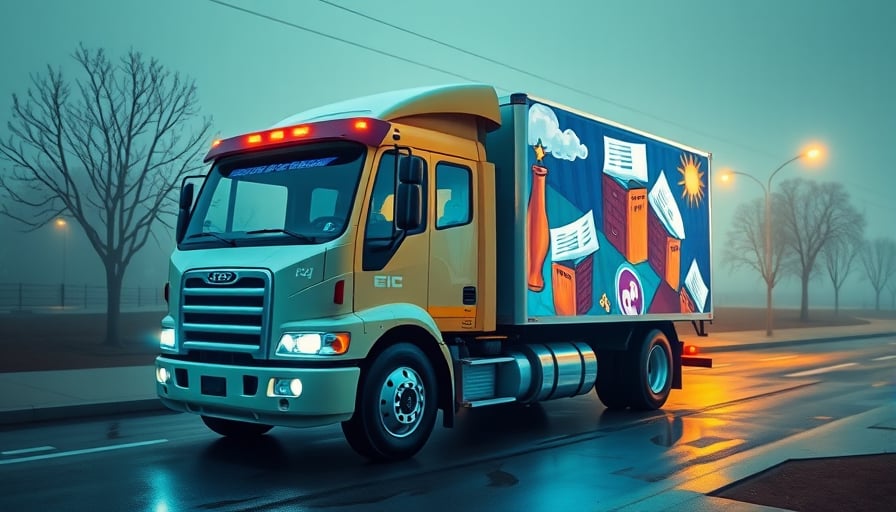
Daimler Truck’s Electrification Milestone: A Symbol of Stagnation
The German commercial‑vehicle titan Daimler Truck Holding AG completed a pivotal yet unremarkable step this week: the first delivery of its new eActros 600 to the French logistics group Transports Vallée and the signing of a framework agreement for up to 500 electric buses. The move, meant to signal a decisive transition from strategy to execution, could not shake the market.
On Friday, the share price slipped 0.72 % to €37.35, a narrow margin from the €37.43 close recorded on 18 December. In a market that celebrated monetary easing by the Federal Reserve, the company’s modest achievements failed to inject fresh optimism. The broader European indices—Stoxx 600, DAX, and LUS‑DAX—climbed only marginally, while the German market’s mixed performance left investors wary.
The Delivery: A Tread‑Minded Victory
The eActros 600 represents Daimler Truck’s flagship effort to electrify its heavy‑truck fleet, a move that could position the company at the forefront of a sector under pressure to cut emissions. Yet the delivery to a single French logistics operator, while a milestone, is a modest one‑off event in the context of the company’s €28.7 billion market cap and €45.33 high in the past year. It does little to alter the fundamental valuation metrics—its P/E ratio of 12.57 already places the stock in a competitive range.
The 500‑unit electric‑bus order, though substantial, is dwarfed by the global demand for low‑emission vehicles. It is unclear whether the firm has the manufacturing bandwidth or the supply‑chain resilience to scale up production to meet the projected growth in the commercial‑vehicle market. Without concrete evidence of a robust scaling strategy, the delivery reads more as a marketing statement than a business turning point.
Market Context: A Resilient but Reluctant Investor Base
European shares finished higher on 19 December, buoyed by expectations of further monetary easing. The DAX’s 0.40 % rise to 24,295.95 points and the LUS‑DAX’s 0.73 % gain illustrate a modest rebound. Nevertheless, German stocks displayed a mixed performance, with the DAX dipping 0.07 % at 24,180.41 during the morning session. Investors remained cautious, weighing the implications of central‑bank policy and recent U.S. inflation data.
In this environment, Daimler Truck’s news—though positive—was dwarfed by broader market forces. The company’s share price reflected the sentiment that incremental progress in electrification, without a clear path to profitability or market share gains, is insufficient to justify a rally.
The Bottom Line
Daimler Truck Holding AG’s first eActros 600 delivery and the 500‑bus agreement demonstrate the company’s willingness to pursue electric solutions. Yet the market’s muted reaction underscores a critical reality: progress on paper does not automatically translate into investor confidence or share‑price strength. For the German automaker to truly capitalize on the electrification trend, it must deliver scalable production, cost efficiency, and a clear competitive advantage—factors that remain unproven at this juncture.
The company’s fundamentals—an 12.57 P/E ratio, a €28.7 billion market cap, and a 52‑week high of €45.33—suggest there is room for upside, but only if the firm can move beyond symbolic milestones and into tangible growth. Until such evidence emerges, the market will likely continue to treat Daimler Truck’s electrification strides as a cautious optimism rather than a transformative breakthrough.