
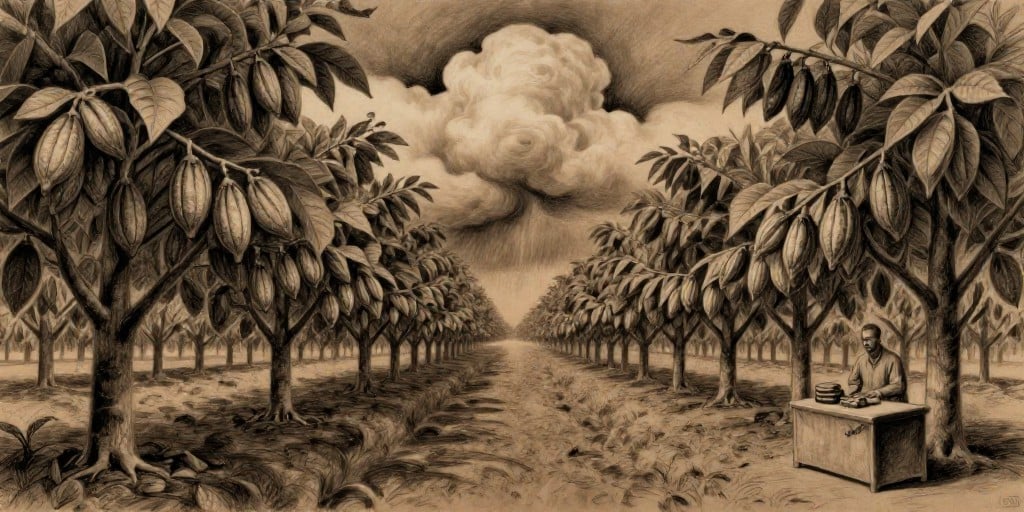
Cocoa Market Faces Contrasting Forces
The raw‑material market for cocoa is currently undergoing a period of notable volatility, with supply dynamics in West Africa, weather‑related risks, and price expectations converging to shape trading activity on global exchanges.
Supply Surge in the Ivory Coast
The largest cocoa producer in the world, Côte d’Ivoire, has reported a significant increase in farmgate output for the 2026/27 crop cycle. According to Barchart and ECOFIN Agency, the country is cutting its farmgate price by 57 % for the upcoming season, a move aimed at stimulating production and improving farmer revenue. In contrast, ESMMagazine notes that the government will keep the reduced price level, indicating a policy of price support despite higher yields. This surge in supply has already begun to press downward on futures prices in both the ICE New York and ICE London markets, with the December contract dropping 2.95 % and 0.86 % respectively on Tuesday, 2 September.
The influx of beans from the Ivory Coast is a key reason behind the recent “ample cocoa supplies” narrative reported by Barchart at 16:35 UTC. Traders in both spot and futures markets have reacted by reducing positions, leading to a retreat from the 11‑month high that the London contract had previously reached.
Weather‑Induced Supply Concerns
While supply from Côte d’Ivoire is rising, other regions are experiencing growing uncertainty. Bloomberg highlighted that Asia’s leading processor, Guan Chong Berhad, warned of a 300,000‑400,000‑ton deficit for the 2026/27 season due to a strengthening El Niño. This weather phenomenon, which intensifies the Harmattan winds in West Africa, has already manifested in higher temperatures, increased rainfall, and a rise in the prevalence of black‑pod disease. Bloomberg’s interview with Ghanaian farmer Simon Essah further illustrated how wet conditions and disease are curbing pod development, reducing overall yields.
These weather‑related risks have prompted the British Marketing Institute (BMI) to project that cocoa prices could climb as high as US$4,990 per tonne if the deficit materializes. Such a scenario would counteract the downward pressure from the Ivory Coast’s expanded output, potentially creating a highly contested price environment.
Market Sentiment and Technical Levels
The current closing price for the cocoa futures contract on the Intercontinental Exchange, as of 31 August 2026, stood at 6,509. This sits roughly 50 % above the 52‑week low of 2,503 (set on 15 February 2026) and below the 52‑week high of 7,644 (recorded on 15 September 2025). The steep decline from the recent peak reflects the market’s sensitivity to supply data and weather forecasts. The 11‑month high reached by London cocoa has been revisited as traders evaluate the interplay between an expanding Ivory Coast supply chain and potential shortages elsewhere.
Implications for Stakeholders
Futures Traders: The juxtaposition of supply growth and weather uncertainty is prompting a cautious stance. The recent price drops suggest a short‑term oversupply, but the risk of a deficit in West Africa keeps the long‑term outlook ambiguous.
Processors and Manufacturers: Companies such as Mondelez, which has publicly stated that healthy cocoa stocks should buffer the impact of weather risks, are likely to adjust hedging strategies. A potential surge in price, as forecasted by BMI, could raise production costs, prompting a reassessment of inventory levels.
Farmers: The reduced farmgate price in Côte d’Ivoire may provide a temporary revenue boost, but the overall profitability will depend on the balance between higher production volumes and the global price environment.
Policy Makers: The divergent approaches—price support in Côte d’Ivoire versus potential price hikes abroad—highlight the need for coordinated policy responses to stabilize the market and safeguard both farmer livelihoods and consumer prices.
In summary, the cocoa market is currently at a crossroads. While the Ivory Coast’s expanded output exerts downward pressure on prices, the looming threat of a significant weather‑related deficit in West Africa introduces a countervailing force. The outcome will hinge on the relative pace of these opposing dynamics and on how quickly the market digests new information.