
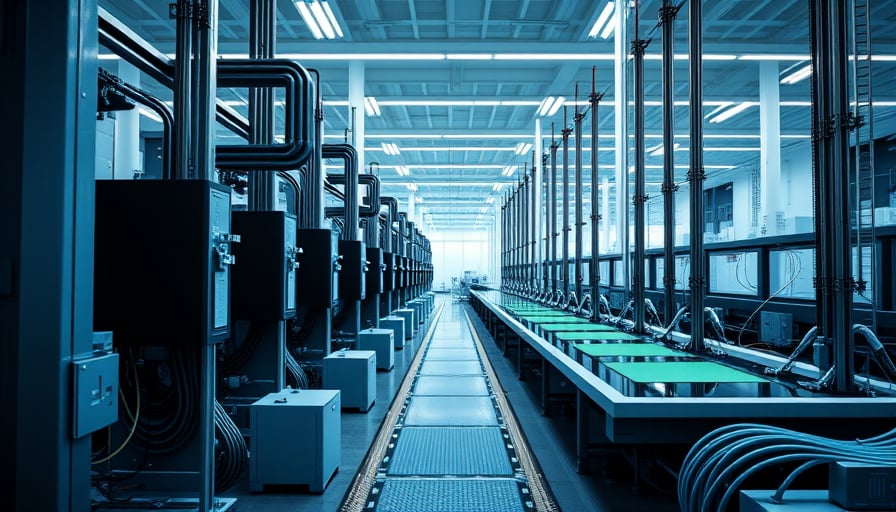
TCL Technology Group Corp: Riding a Wave of Semiconductor and AI‑Driven Growth
TCL Technology Group Corp., a Shenzhen‑listed semiconductor display manufacturer, has positioned itself at the nexus of two transformative trends: the rapid expansion of the semiconductor supply chain and the accelerating deployment of artificial intelligence (AI) across China’s industrial landscape. The company’s latest earnings outlook, coupled with recent corporate governance actions, underscores its commitment to capitalizing on these opportunities.
2025 Earnings Outlook – A Leap in Profitability
On 19 January 2026, TCL Technology Group disclosed a forward‑looking profit forecast for the 2025 fiscal year. Management anticipates a net profit attributable to shareholders between CNY 4.21 bn and CNY 4.55 bn, reflecting a 169 % to 191 % year‑over‑year increase. This surge is largely attributed to continued strength in the company’s flagship product lines—large‑format TVs and commercial displays—whose demand remains robust in both domestic and overseas markets. The forecast also hints at a broadened revenue base, as TCL expands its portfolio of flexible OLED, active‑matrix OLED, and thin‑film transistor liquid‑crystal display technologies.
From a valuation perspective, the company’s price‑to‑earnings ratio of 29.99 indicates that investors are willing to pay a premium for the expected upside, consistent with a market that recognizes the strategic significance of TCL’s technology leadership within the semiconductor display arena.
Corporate Governance – Board Deliberations and Strategic Direction
The same day, the company announced that it had concluded the 19th meeting of the 8th Board of Directors. While the minutes are available in full on the China Securities Regulatory Commission’s (CSRC) website, key takeaways highlight deliberations on:
- Capital allocation: Approving targeted investments in research and development to accelerate the transition from traditional LCD to next‑generation OLED and quantum‑dot displays.
- Supply‑chain resilience: Strengthening relationships with key raw‑material suppliers and expanding manufacturing capacity in China and Southeast Asia to mitigate geopolitical risks.
- Talent acquisition: Initiatives aimed at attracting top semiconductor engineers and data‑science specialists, reflecting a broader industry push towards AI‑enabled design and manufacturing workflows.
These governance actions reinforce TCL’s strategic focus on sustaining high growth while safeguarding operational stability.
Market Reaction – A Positive Spin on the Share Price
In the days leading up to the earnings announcement, TCL’s stock exhibited modest gains. During a session that saw the “光伏龙头ETF” (516290) surge 1.37 % in volume, TCL’s shares climbed slightly above 2 %. Although the broader market experienced volatility, the incremental lift in TCL’s valuation was a sign that investors perceived the company’s earnings forecast as credible and its strategic initiatives as forward‑looking.
The modest outperformance relative to the broader sector—especially in an environment where semiconductor peers such as Tianjin Jin Hai Tong Semiconductor Equipment and Lianxi Technology are also reporting strong forecasts—suggests that TCL’s diversified product mix and global footprint are key differentiators.
AI Growth Engine – A Contextual Backdrop
The broader narrative of AI’s integration into China’s industrial upgrade strategy, highlighted in a 19 January 2026 China Daily feature, frames TCL’s growth prospects. The article emphasized that AI technologies, particularly large multimodal language models, are poised to unlock efficiency gains across manufacturing, logistics, and service sectors. For a company like TCL, which operates at the intersection of hardware and software, AI-driven process optimization—ranging from yield prediction to automated defect inspection—offers a tangible route to cost reduction and time‑to‑market acceleration.
Furthermore, the AI emphasis aligns with TCL’s own R&D thrusts in flexible printing display OLED and active‑matrix OLED technologies, where machine‑learning algorithms are increasingly employed to refine pixel‑level calibration and enhance color accuracy. As AI matures, TCL’s ability to embed intelligence into its display products may become a competitive moat, especially as consumer and enterprise demand for high‑resolution, low‑power displays escalates.
Outlook – Navigating Opportunities and Risks
Looking forward, TCL Technology Group’s trajectory is shaped by several converging factors:
| Driver | Impact |
|---|---|
| Global display demand (particularly in automotive, VR/AR, and smart‑home sectors) | Positive growth, though subject to macro‑economic cycles |
| AI‑enabled manufacturing | Cost efficiencies, higher yield, faster product iteration |
| Supply‑chain volatility (raw material price swings, geopolitical tensions) | Potential cost pressures; mitigated by diversified sourcing |
| Regulatory environment (Chinese semiconductor policy, export controls) | Supports domestic capacity expansion, but may impose constraints |
While the 2025 earnings forecast paints an optimistic picture, investors should remain cognizant of the cyclical nature of the display market and the evolving competitive dynamics in semiconductor manufacturing. TCL’s proactive board governance and its strategic alignment with China’s AI‑driven industrial upgrade blueprint, however, provide a solid foundation for sustained value creation.
In sum, TCL Technology Group Corp. exemplifies a company that is not only riding the crest of current semiconductor demand but also strategically positioning itself to thrive in the next wave of AI‑powered manufacturing and product innovation.