
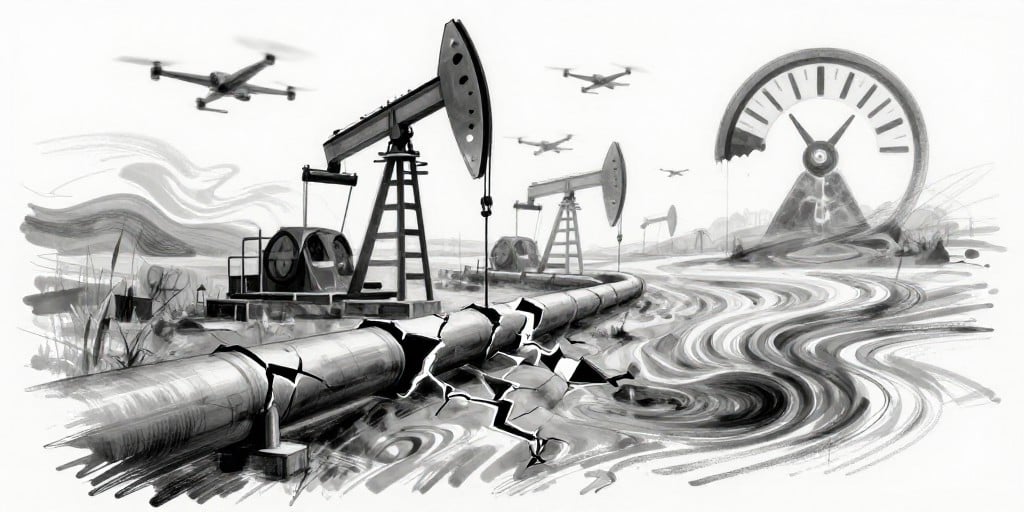
LUKOIL PJSC Faces Escalating Operational and Geopolitical Headwinds
LUKOIL PJSC, Russia’s leading oil and gas conglomerate, is confronting a convergence of operational disruptions, supply‑chain constraints, and geopolitical pressures that threaten to erode its market position and financial stability. The company’s recent exposure to Ukraine‑driven attacks, mounting fuel‑sales restrictions, and a fragile global oil market underscores a precarious future.
1. Direct Impact of the Ukraine‑Infected Volga Refineries
Two separate reports on July 2, 2026 detail a Ukrainian drone strike on a LUKOIL‑owned refinery in the Volga region. The assault, confirmed by the Russian governor of the area and the Ukrainian Security Service (SBU), resulted in a fatality and multiple injuries. Images released online depict flames engulfing the Kstowo refinery, one of the largest processing facilities in Russia. The strike’s immediate consequences are:
- Production Downtime: The refinery’s output is likely to decline until repairs are completed, reducing LUKOIL’s crude throughput and downstream product supply.
- Supply Chain Disruption: A loss of a major processing node strains the company’s ability to meet domestic and international demand, potentially inflating feedstock costs for remaining refineries.
- Reputational Damage: Repeated attacks erode investor confidence, especially as the refinery is a flagship asset that underpins LUKOIL’s global reputation.
The company’s resilience hinges on the speed and effectiveness of its repair strategy, as well as on its ability to reroute crude to alternative facilities.
2. Russia’s Fuel‑Sales Restrictions Exacerbate Market Pressure
Earlier on July 1, 2026, the Russian government announced that fuel‑sales restrictions had expanded to more than 40 regions, covering Volga, Siberia, and the Far East. The decree limits the quantity of gasoline and diesel each vehicle may purchase, with some areas prohibiting sales in portable containers altogether. These measures aim to mitigate shortages but also:
- Compress Retail Margins: Fuel stations, many of which are subsidiaries or partners of LUKOIL, face reduced transaction volumes, squeezing profit margins.
- Stoke Public Unrest: As travel and commerce rebound during the summer, tightened fuel availability may trigger consumer backlash, potentially leading to protests that could further destabilize the sector.
- Create Logistics Challenges: Distributing fuel across a sprawling nation under restrictive conditions increases operational costs and complicates inventory management.
Given LUKOIL’s extensive network of refineries and gas stations, the company must adapt quickly to a new consumption landscape that may erode its core revenue streams.
3. Market Sentiment Amid Geopolitical Uncertainty
Oil price dynamics remain volatile. UBS’s recent sharp down‑shift in price forecasts, coupled with a modest rebound in benchmark prices due to short covering after progress in Doha talks, indicates that traders are highly sensitive to geopolitical cues. LUKOIL’s price‑earnings ratio of 57.58 suggests that the market expects substantial earnings growth, yet:
- Supply Surplus Signals: Sell‑side revisions anticipate a near‑term surplus, potentially lowering crude prices and squeezing upstream margins.
- Demand‑Side Weakness: The U.S.–Iran talks and resumption of Strait of Hormuz flows signal a gradual return of supply, which may dampen demand for Russian oil amid ongoing sanctions and export restrictions.
- Currency Exposure: The company’s primary trading currency, RUB, remains volatile against global benchmarks, adding an extra layer of risk to its international sales and procurement strategies.
4. Strategic Opportunities and Risks
Opportunities
- Diversification into Petrochemicals: LUKOIL’s existing petrochemical operations can offset losses in crude production by capturing higher‑margin downstream markets.
- Bilateral Agreements: The 30‑June approval allowing the Bulgarian refinery to purchase oil from Swiss counterparties demonstrates a willingness to pursue cross‑border deals that can stabilize supply lines.
- Domestic Market Share: With foreign competitors facing sanctions, LUKOIL could consolidate its position in Russia’s energy market, benefiting from a protected domestic customer base.
Risks
- Continued Drone Attacks: The Volga refinery is only one of many assets vulnerable to Ukrainian drone strikes, posing a systemic threat to production capacity.
- Regulatory Crackdowns: Fuel‑sales restrictions may become more stringent if shortages persist, further eroding retail revenue.
- International Sanctions: Ongoing Western sanctions could limit LUKOIL’s access to technology and capital markets, curtailing its growth prospects.
5. Conclusion
LUKOIL PJSC stands at a crossroads. Its entrenched market presence, coupled with a robust portfolio of refining and petrochemical assets, provides a solid foundation. Yet the convergence of Ukraine‑driven attacks, Russian fuel‑sales restrictions, and a shifting global oil market creates a precarious environment that could destabilize earnings and market perception. The company’s survival will hinge on its agility in responding to operational shocks, its ability to leverage domestic advantages, and its prudence in navigating an increasingly hostile geopolitical landscape.