
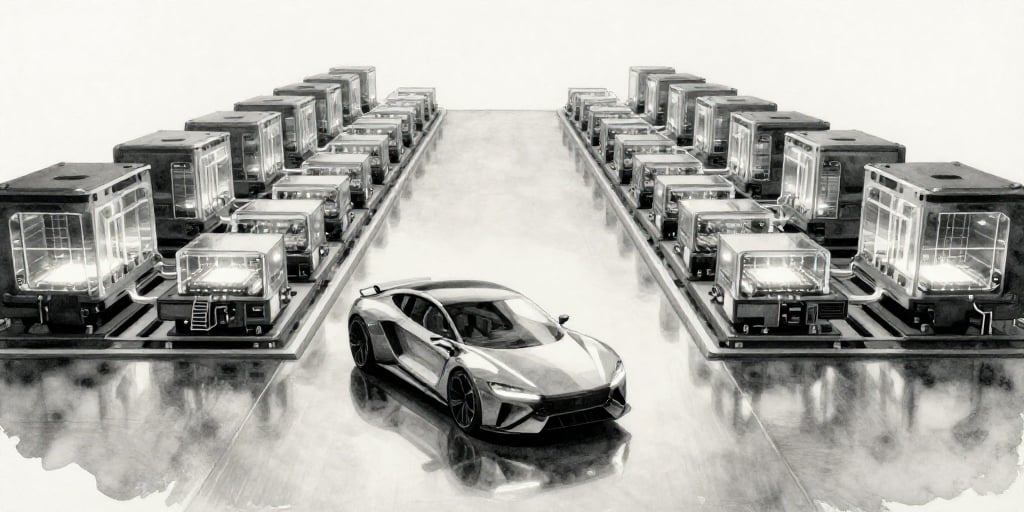
Huizhou Desay SV Automotive Co., Ltd. Amid the Surge of Nvidia‑Driven AI Demand
Huizhou Desay SV Automotive Co., Ltd. (ticker: DSA on the Shenzhen Stock Exchange) is a Chinese manufacturer and distributor of automotive components. Its product portfolio spans infotainment systems, air‑conditioning controllers, driver‑information displays, driver‑assistance systems, and a variety of other electronic modules that are integrated into vehicles sold throughout China. With a market capitalization of 61.51 billion CNY and a price‑to‑earnings ratio of 25.55, the company sits comfortably within the consumer discretionary sector and the household durables industry.
Nvidia’s Expansion into Physical AI and the Ripple Effect on Asian Supply Chains
In early May 2026, Nvidia Corp. intensified its focus on physical artificial‑intelligence (AI) infrastructure. The company’s strategy to embed AI chips and software into a broad spectrum of manufacturing and product‑development ecosystems has sparked a renewed interest in its regional supply‑chain partners. Reports from Bloomberg, Business Insider, and other financial outlets noted that a growing list of Asian firms—ranging from South Korea’s LG Electronics to Taiwan’s Nanya Technology—have been rallying in response to announced collaborations, supply‑chain participation, or product‑level linkages with Nvidia.
Huizhou Desay SV Automotive is among the Chinese manufacturers that have recently benefited from this trend. The company’s participation in Nvidia‑related supply‑chain initiatives, whether through the supply of electronic modules compatible with Nvidia‑powered AI platforms or through joint development projects, has positioned it as a strategic ally in the expanding AI ecosystem.
Immediate Market Impact
Shares of Huizhou Desay SV Automotive surged in the days following the announcement of its ties to Nvidia. The stock’s performance mirrored that of its counterparts in the region, reflecting investor enthusiasm for firms that are poised to capture the growing demand for AI‑enabled automotive components. The company’s closing price as of 29 April 2026 was 103.07 CNY, comfortably below its 52‑week high of 154.17 CNY (recorded 24 September 2025) and above its 52‑week low of 95.6 CNY (recorded 16 June 2025). This upward momentum suggests that the market views the partnership as a credible catalyst for future growth.
Broader Context: China’s Ascendancy in the Global Automotive Parts Landscape
A recent in‑depth report from Weber Consulting—published on 3 May 2026—highlighted China’s rapid rise in the global automotive parts sector. While traditional powerhouses such as Japan, the United States, and Germany continue to dominate in certain sub‑segments (chip manufacturing, precision engineering, optics), Chinese firms have carved out a significant presence in body‑in‑white components, stamping, battery modules, motors, and electrical systems.
According to the report, 15 Chinese companies have entered the global top‑100 list of automotive parts suppliers, marking a substantial leap from previous years. Huizhou Desay SV Automotive’s inclusion in this cohort underscores its role as a key contributor to China’s competitive positioning. The company’s focus on high‑tech electronic modules aligns well with the global shift toward connected, autonomous, and electrified vehicles.
Strategic Outlook
The convergence of Nvidia’s AI ambitions and Huizhou Desay SV Automotive’s core competencies presents a compelling narrative for investors and industry observers alike. By integrating AI‑enhanced functionalities into its product line, the company is not only responding to current market demands but also positioning itself for the next wave of automotive innovation.
While the company’s P/E ratio of 25.55 suggests a valuation that is moderately above the industry median, the recent surge in share price indicates that market participants are already pricing in the potential upside derived from the Nvidia partnership and the broader AI-driven automotive transformation.
In sum, Huizhou Desay SV Automotive exemplifies how a mid‑cap Chinese supplier can leverage strategic alliances with global tech leaders to accelerate growth, enhance its product portfolio, and solidify its standing in an increasingly competitive and technologically advanced industry.