
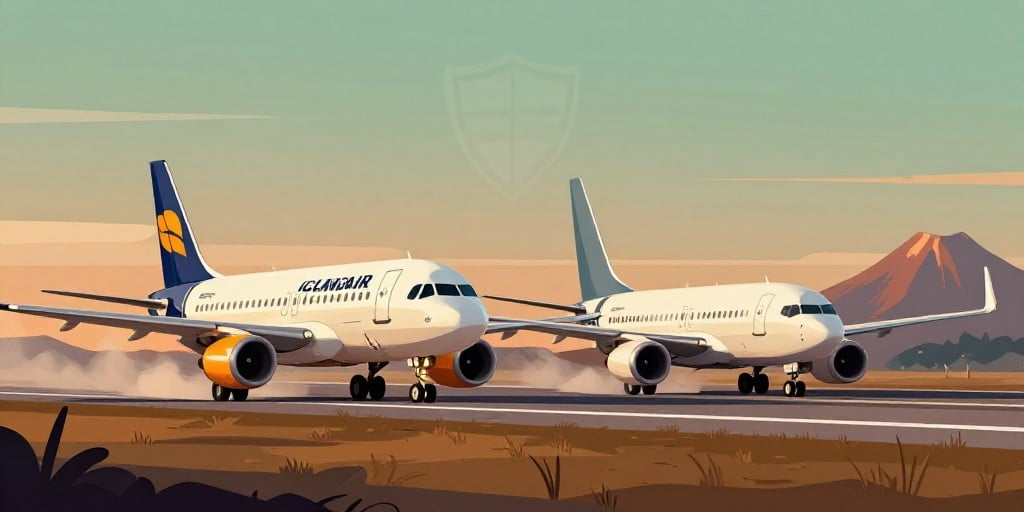
Icelandair Group’s Fleet Modernisation and Operational Developments
Icelandair Group Holdings hf continues to pursue a strategic trajectory that balances fleet renewal with operational resilience. Recent announcements and incident reports provide a nuanced view of the airline’s current positioning within the highly competitive passenger‑airlines sector.
1. New Airbus A320neo Lease Commitments
On 29 July 2026, Icelandair disclosed that it has signed lease agreements with the aircraft lessor Aircastle for six Airbus A320neo aircraft. These aircraft are slated to enter service before the summer of 2028. The move is part of a broader fleet‑renewal program that complements the four Airbus A320neo aircraft already under lease, reinforcing the airline’s focus on fuel‑efficient, lower‑operating‑cost platforms. By transitioning to the A320neo family, Icelandair positions itself to better meet evolving environmental standards and to maintain competitive point‑to‑point services across Europe and the North Atlantic corridor.
2. Cessation of Boeing 757/767 Operations
Icelandair has announced the termination of its Boeing 757 and 767 operations in the coming year. While the airline had maintained a mixed fleet that included these older narrow‑body and wide‑body models, the decision reflects a strategic shift toward the A320neo series and the continued use of its 737‑MAX fleet. The retirement of the 757/767 will streamline maintenance, crew training, and spare‑parts logistics, further reducing overheads and enhancing operational flexibility.
3. Boeing 737‑MAX Fleet Composition
Icelandair operates 21 Boeing 737‑MAX aircraft, a fleet that has attracted attention due to the broader industry concerns surrounding the 737‑MAX family. According to the airline, the 737‑MAX aircraft were purchased from Boeing without seats, allowing Icelandair to source seating from an Italian manufacturer whose designs better align with the airline’s service standards and passenger‑experience benchmarks. This approach has proven advantageous in maintaining a consistent cabin environment, as the airline has historically sourced seats from independent manufacturers to preserve brand identity and customer satisfaction.
4. Incident at Keflavík International Airport
A significant operational disruption occurred at Keflavík International Airport on 26 July 2026, when an Icelandair aircraft experienced a critical failure in the emergency exit system during a flight to Alicante, Spain. The incident forced the disembarkation of approximately 131 passengers—roughly half of the aircraft’s load—at the departure airport. Passengers were subsequently relocated to alternate flights, resulting in multiple flight delays and a temporary halt in operations for the affected crew and aircraft. The airline’s immediate response included a thorough investigation of the emergency exit mechanism and coordination with the Icelandic Civil Aviation Authority to mitigate future risks.
5. Implications for Financial Positioning
These developments—fleet renewal, the phasing out of legacy aircraft, and proactive seat‑management strategies—are consistent with Icelandair’s broader objective of achieving operational efficiency and cost optimisation. While the lease commitments for new Airbus aircraft represent a capital outlay, they are offset by anticipated savings in fuel consumption, maintenance, and crew utilisation. Moreover, the decision to retire older Boeing models is expected to reduce depreciation charges and spare‑parts inventory costs.
The incident at Keflavík, while operationally disruptive, underscores Icelandair’s commitment to passenger safety and regulatory compliance. The swift management of the emergency situation and subsequent remedial measures are likely to reinforce stakeholder confidence in the airline’s crisis‑management protocols.
6. Forward‑Looking Outlook
With the A320neo fleet expansion on schedule and a streamlined 737‑MAX and A320neo combination, Icelandair is poised to enhance its network footprint across Europe and North America. The strategic focus on fuel‑efficient aircraft, coupled with a disciplined approach to cabin standardisation, positions the airline to adapt to tightening environmental regulations and volatile fuel markets. Continued vigilance in safety oversight and operational reliability will remain paramount as the group navigates the complexities of the global aviation landscape.