The global stable‑coin landscape in late 2026: regulatory convergence, market expansion, and key player activity
The past week has seen a sharp uptick in regulatory scrutiny and institutional commitment to stable‑coin ecosystems across multiple jurisdictions. Central banks and stock‑exchange operators are increasingly positioning themselves as both issuers and enablers of digital tokens that maintain a fixed peg to fiat currencies. The following synthesis distills the most consequential developments and outlines their implications for market participants and potential investors.
1. Central‑bank‑led pressure in Argentina
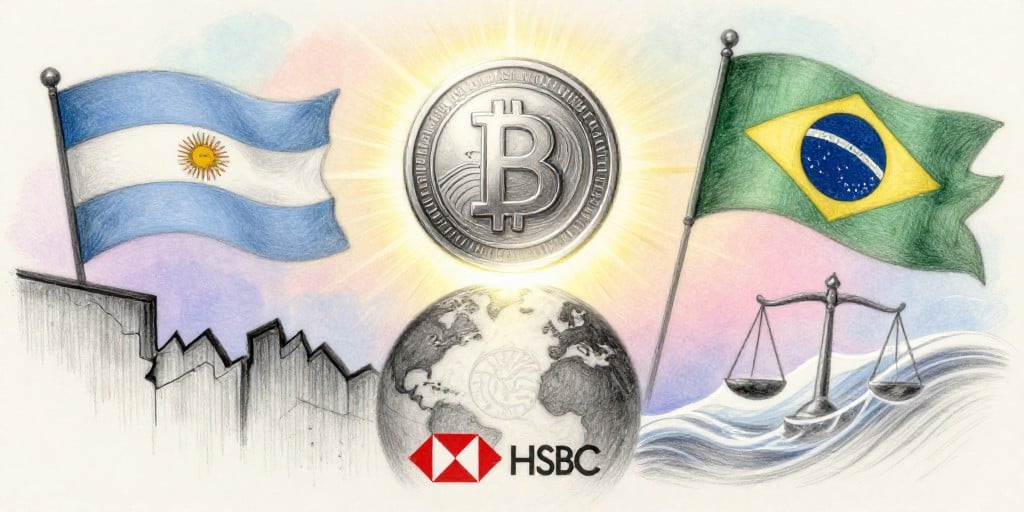
Argentina’s monetary authority has signaled a more aggressive stance toward the MEP dollar and stable‑coins, requesting that digital wallets and crypto platforms temper transactions involving the off‑market dollar. While the move does not directly involve any U.S.‑listed entity, it reflects a broader trend of sovereign regulators tightening control over digital assets that could serve as an alternative to traditional payment rails. The policy signals that market participants in emerging economies must remain vigilant about evolving compliance frameworks and that the regulatory environment in the region may shift from permissive to restrictive.
2. Institutional adoption in South Korea and Brazil
South Korea’s Financial Services Commission has proposed legislation that would grant banks a central role in the country’s stable‑coin market while tightening ownership restrictions. Concurrently, Brazil’s B3 is collaborating with six major banks to launch a real‑pegged stablecoin, Open BRL, slated for a first‑quarter 2027 launch. The Brazilian initiative represents one of the most ambitious state‑backed stable‑coin projects to date, featuring a one‑to‑one backing of reais and a robust governance structure. This dual‑front regulatory push signals that stable‑coins are becoming integral to national payment systems rather than merely speculative assets.
3. Bank‑issued stable‑coins gain traction
A series of articles from Analytics Insight and Benzinga highlight the growing adoption of bank‑issued stable‑coins. HSBC’s recent stable‑coin rollout, which attracted 100,000 users in a month, demonstrates the commercial viability of digital fiat equivalents in mainstream banking. Additionally, Ripple’s XRP Ledger is poised to unlock approximately $837 million in stable‑coin opportunities, underscoring the potential for blockchain platforms to serve as infrastructure for fiat‑backed tokens. These developments reinforce the narrative that traditional financial institutions are now serious contenders in the stable‑coin arena, leveraging their regulatory familiarity and customer base to drive adoption.
4. Market sentiment and price dynamics
Recent market commentary on Analytics Insight indicates that XRP’s price remains near the USD 1 threshold as the company prepares for a December token unlock. Although not a direct stable‑coin, XRP’s role as a bridge asset for many stable‑coin protocols keeps it in the spotlight. Concurrently, research from Orbital suggests that stable‑coin fees could add 10 % to a $20 purchase ahead of high‑spend periods such as Black Friday, raising concerns about the cost‑competitiveness of digital fiat compared to traditional payment methods.
5. Regulatory enforcement in the United States
U.S. authorities are targeting more than USD 1.1 billion in cryptocurrency tied to the October Binance hack. The intensified effort to recover assets illustrates the willingness of federal agencies to pursue cross‑border crypto investigations, a factor that could influence how stable‑coins are perceived by risk‑averse institutional investors.
6. Outlook for investors and market participants
The convergence of regulatory clarity, institutional backing, and market momentum suggests that stable‑coins are moving from a speculative niche toward mainstream financial infrastructure. For investors with exposure to fintech, blockchain, or digital‑currency markets, the 2026–2027 horizon offers opportunities to capitalize on the expansion of bank‑issued and state‑backed stable‑coins. However, the emerging fee structures, regulatory adjustments, and geopolitical dynamics—particularly in Latin America and Asia—necessitate a careful, data‑driven approach to asset allocation.
In sum, the global stable‑coin ecosystem is undergoing a pivotal transformation. The interplay of regulatory actions in Argentina, South Korea, and Brazil; the strategic moves by HSBC and Ripple; and the U.S. enforcement actions collectively shape a landscape where stability, compliance, and innovation will determine the next wave of digital‑fiat adoption.