
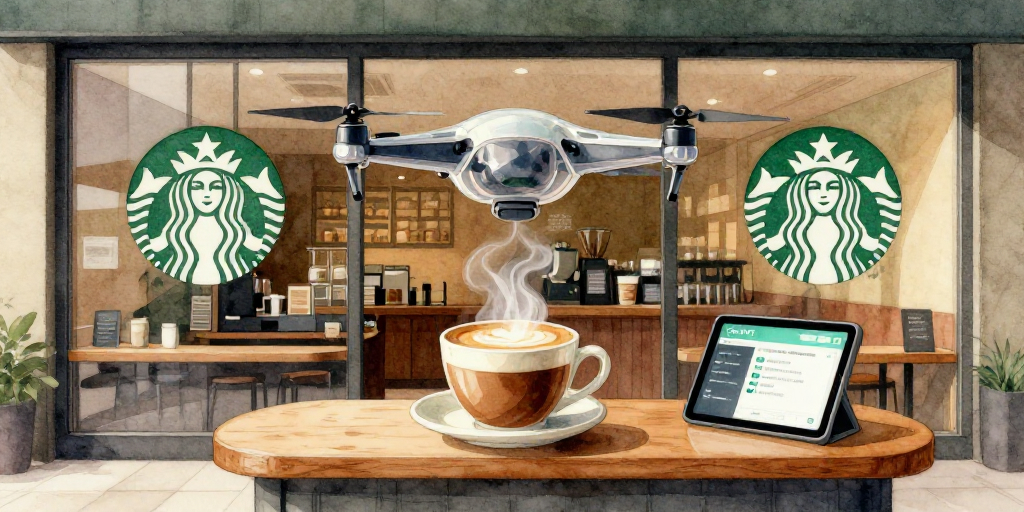
Starbucks Corp. Accelerates Its Digital Push Amid Mixed Market Sentiment
Starbucks Corporation (NASDAQ: SBUX) has once again positioned itself at the intersection of consumer convenience and technological innovation. The coffee giant’s latest initiatives—most notably the rollout of a ChatGPT‑powered “beta app” for drink discovery and a nascent drone‑delivery trial—have stirred both enthusiasm and skepticism among investors and analysts alike. These moves come as the stock hovers near its year‑high, trading around $98.47 after surpassing the 12‑month analyst target of $98.19.
A New Generation of Customer Engagement
On April 15, 2026, Starbucks announced a beta integration within ChatGPT that allows users to describe a mood or flavor profile and receive personalized drink suggestions. The feature, unveiled at a press briefing, is described as a conversational tool that can “help customers discover new drinks through prompts” rather than the traditional menu‑driven approach. Early reports from CoinCentral and Blockonomi highlight the potential for increased first‑visit sales and higher average order values, as customers are guided to novel, seasonal offerings without the friction of menu selection.
The initiative aligns with CEO Brian Niccol’s broader strategy of “leveraging AI to enhance personalization.” While the beta is still in its infancy, the market reacted positively, with SBUX shares climbing 17 % year‑to‑date—the largest gain among consumer discretionary stocks this quarter. Analysts note that the AI integration could unlock new revenue streams by promoting premium, limited‑time items that resonate with specific customer segments.
Drone Delivery: A Bold but Uncertain Experiment
Only two days later, on April 17, 2026, TipRanks reported that Starbucks had launched a pilot drone‑delivery service. The initiative, dubbed “How Do You Deliver Without Spilling?”, aims to test the feasibility of aerial drops for same‑day delivery in urban markets. While the company’s public statement emphasizes a commitment to “speed and safety,” critics argue that the logistical challenges—regulatory hurdles, battery life, and consumer perception—may outweigh the marginal gains.
The drone trial coincides with the company’s broader push into “contactless” solutions, a trend that gained traction during the pandemic. However, unlike the AI chatbot, the drone effort has yet to demonstrate clear ROI. Investors will be watching closely to see whether this bold experiment translates into tangible sales growth or simply becomes a costly marketing stunt.
Dividend Signal and Market Valuation
Starbucks also announced a cash dividend on April 16, 2026, a move described by TipRanks as a “condescending” yet strategic gesture to reassure income‑oriented investors. The dividend signals confidence in the company’s free‑cash‑flow generation and may help cushion the stock against volatility stemming from its tech‑centric initiatives.
From a valuation standpoint, the stock sits at a price‑to‑earnings ratio of 82.32, a figure that has long been a point of contention among market participants. AInves reported that SBUX’s valuation is 37 % higher than its discounted cash‑flow estimate, underscoring the premium investors are willing to pay for the brand’s perceived moat and growth prospects.
Consumer‑Facing Moves: The 2026 Summer Menu
While the corporate‑tech narrative dominates headlines, Starbucks is also refreshing its product portfolio. The company unveiled its 2026 summer menu on April 15, 2026, reintroducing fan‑favorite items and launching a series of limited‑time offerings. According to Myrtle Beach Online, the new lineup includes seasonal drinks that are designed to appeal to both traditional coffee lovers and adventurous consumers looking for novel flavor combinations.
These menu tweaks, though modest in scale, play a critical role in sustaining the brand’s relevance amid intensifying competition from fast‑food giants and niche coffee shops. By pairing menu innovation with AI‑driven personalization, Starbucks is attempting to create a seamless, “menu‑less” experience that could redefine customer expectations.
Broader Industry Context
The coffee‑house segment remains fiercely competitive, with rivals such as McDonald’s and Dutch Bros expanding their beverage portfolios. The Motley Fool noted that McDonald’s beverage push could have ripple effects on smaller players like Dutch Bros, potentially diluting Starbucks’ market share if the company fails to differentiate its offerings effectively.
Moreover, the global coffee market faces supply‑chain uncertainties, particularly in China, where Starbucks has previously grappled with consumer sentiment. Der Aktionär highlighted that the company’s “new era” hinges on revitalizing its China operations, a challenge that the drone and AI strategies may not directly address.
Conclusion
Starbucks Corp. is walking a tightrope between innovation and tradition. The company’s AI‑powered ChatGPT integration and experimental drone delivery signal an aggressive push into the digital frontier, while its summer menu refresh and dividend issuance aim to shore up core consumer demand and investor confidence. Whether these dual strategies will translate into sustainable revenue growth remains to be seen, but the market’s bullish response—evidenced by the recent price gains and analyst target revisions—suggests that the gamble has already paid off, at least in the short term. Investors will need to monitor the rollout metrics closely: will the AI bot drive incremental sales, and will drone delivery overcome its logistical barriers? The answers to these questions will determine whether Starbucks can truly transform itself from a coffee retailer into a fully integrated digital lifestyle brand.