
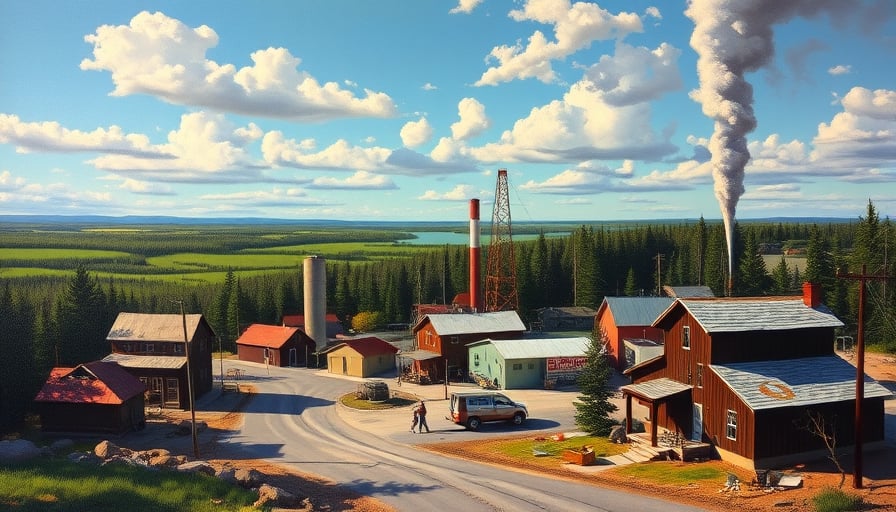
Ontario Grants STLLR Gold the First Recovery of Minerals Permit for Hollinger Tailings
On February 12 2026, the Ontario government issued the province’s inaugural Recovery of Minerals permit, granting Toronto‑based STLLR Gold Inc. the legal authority to explore the waste rock left behind by the Hollinger Mine in Timmins. This decision marks a watershed moment for the company, positioning it to tap into an estimated 19.5 million tonnes of gold‑rich tailings that were deposited between 1915 and the 1960s.
The Opportunity in the Waste
STLLR’s executive team argues that the 50‑60 million tonnes of spoil surrounding the Hollinger site still contain recoverable bullion. At current gold prices, which recently peaked at US$5,080 per ounce, the financial upside is substantial. The company plans to employ cyanidation—an electrochemical technique capable of extracting gold even from low‑grade ores—to turn the tailings into a profitable operation by 2027. In a statement, Chief Executive Keyvan Salehi framed the project as a “triple win”: lucrative cash flows, responsible remediation of a century‑old site, and sustainable prosperity for Timmins and its surrounding communities.
A New Regulatory Landscape
Ontario’s new Recovery of Minerals regime, enacted under Bill 5 (the Protect Ontario by Unleashing the Economy Act), was designed explicitly to reduce bureaucratic friction for projects that revitalize abandoned or legacy mines. The act promises to halve permit times to a maximum of two years, introduces a single point of contact for all provincial approvals, and repeals certain environmental protections that critics claim have stalled mining development. While the province touts the initiative as a catalyst for economic growth, Indigenous and environmental groups have voiced alarm that disturbing old mining sites may re‑release toxic substances into the environment.
The Hollinger permit exemplifies the province’s commitment to the new framework. Energy and Mines Minister Stephen Lecce highlighted that the project demonstrates the effectiveness of Ontario’s streamlined process and its capacity to transform legacy sites into engines of growth. The permit also signals that the government is willing to accept the risks associated with re‑exploration of historic mine sites in the name of economic progress.
Market Context and Investor Sentiment
STLLR Gold’s market capitalization hovers at CAD 241.92 million, with a closing share price of CAD 1.72 as of February 12. The company’s price‑earnings ratio sits at –8.2, reflecting a lack of earnings but underscoring the speculative nature of its current pipeline. The 52‑week range—from a low of CAD 0.71 in May 2025 to a high of CAD 1.88 in January 2026—illustrates the volatility surrounding the company’s valuation.
Given the recent regulatory green light and the high gold price environment, investors may view this permit as a turning point. However, the company still faces significant technical, environmental, and community‑relations risks that could derail the project. The real challenge lies in translating a regulatory victory into a profitable operation while managing stakeholder expectations and environmental safeguards.
The Bigger Picture
Ontario’s approval of the Hollinger project is part of a broader trend of brown‑field mining resurgence. Similar projects, such as the Canadian Malartic gold mine operated by Agnico Eagle and the potential copper revival in Quebec’s Gaspé region, demonstrate that re‑activating old mines can yield massive outputs when commodity prices justify the investment. STLLR Gold’s success—or failure—will likely influence how aggressively Ontario, and potentially other jurisdictions, pursue legacy‑site development in the future.
In short, the first Recovery of Minerals permit awarded to STLLR Gold signals a bold gamble: the company will attempt to monetize a vast, neglected resource while navigating an evolving regulatory and environmental landscape. Whether the gamble pays off remains to be seen, but the stakes are unmistakably high for the company, the province, and the communities that stand to benefit—or suffer—from this renewed mining effort.