Symbotic Inc.: A Case Study in the Pitfalls of Over‑Promised Robotics
The recent price trajectory of Symbotic Inc. (NASDAQ: SYM) has once again proven the cautionary words of financial commentator Jim Cramer. Two separate articles—published by InsiderMonkey and Yahoo Finance on March 28, 2026—highlight that the company’s shares have failed to deliver the explosive returns that early hype suggested. The narrative that followed is not an isolated anomaly; it is symptomatic of a broader reckoning in the robotics‑automation sector.
Symbotic’s Business Model Under Scrutiny
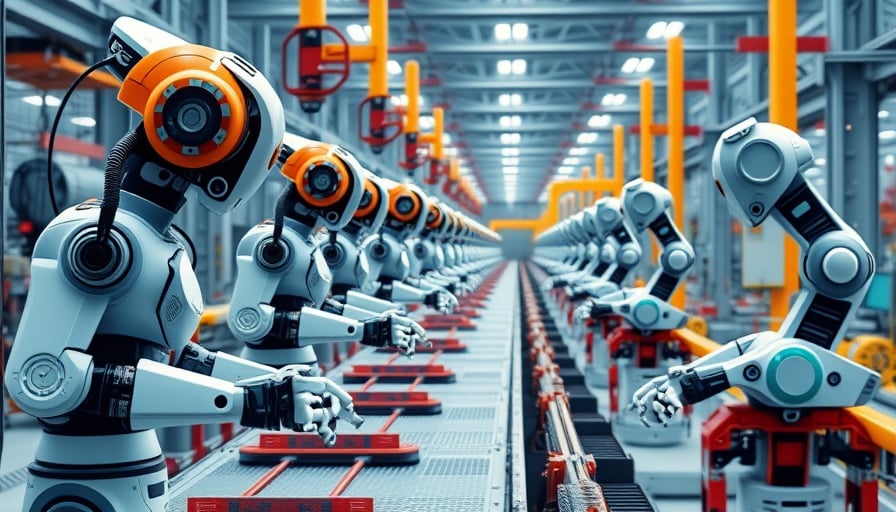
Symbotic, an automation‑technology firm headquartered in Wilmington, positions itself as a leader in AI‑powered, end‑to‑end robotic and software solutions for supply‑chain management. Its flagship platform promises to replace or augment human labor in retail, wholesale, and food‑service warehouses. While the company’s website touts high‑profile partnerships, the on‑ground reality diverges from the headline promises.
- Valuation Gap: Symbotic’s market cap sits at roughly $30 billion, yet the firm’s price‑earnings ratio is a staggering –490.29. Such a negative ratio indicates that earnings are far behind the stock price, a warning sign that the market is pricing in future profitability that has not yet materialised.
- Historical Volatility: Over the past year, the stock has swung from a 52‑week high of $87.88 to a low of $16.32, underscoring the speculative nature of its valuation.
- Operational Uncertainty: The company’s core technology—robotic automation powered by generative AI—has faced significant technical hurdles. While generative models are now capable of learning by observation, transferring that learning to physical hardware remains a costly, time‑consuming process.
Why the Market Is Re‑evaluating
Three key dynamics are reshaping the robotics landscape, many of which directly impact Symbotic’s prospects:
Cost Compression vs. Capital Intensity According to Finanzen.net, robotics costs have been falling dramatically—from $150,000 per unit to an estimated $50,000. While this trend lowers entry barriers, it also erodes the premium margins that companies like Symbotic relied upon. The price drop forces firms to compete on price rather than on differentiated, AI‑enhanced features.
Reshoring and the Labor‑Cost Imperative The resurgence of reshoring in high‑wage economies has made automation a necessity rather than an optional upgrade. However, the automation solution must be demonstrably superior to human labour in terms of reliability, safety, and cost. Symbotic’s track record of deploying robust, production‑ready robots is, at best, mixed.
Physical AI—A Double‑Edged Sword As Finanzen.net notes, AI is now being embodied. Robots that make decisions in milliseconds are no longer a laboratory curiosity; they are a competitive differentiator. Yet the integration of real‑time AI into physical systems introduces latency, safety, and regulatory challenges that can stall deployment—challenges Symbotic has struggled to overcome.
Competitive Pressure From Bigger Players
While Symbotic seeks to dominate niche warehouse operations, larger logistics conglomerates are deploying their own robotic solutions at scale:
- Amazon’s Last‑Mile Innovations: A PYMNTS.com article outlines Amazon’s acquisition of ΔRIVR’s four‑legged robots to address last‑mile delivery bottlenecks. Amazon’s deep integration of robotics across its supply chain, combined with its vast data ecosystem, provides a competitive moat that Symbotic cannot easily breach.
- Service‑Robotics and Uber Spin‑Outs: The failed Scout delivery robot and subsequent attempts by Serve Robotics illustrate the difficulty of translating a robotics concept into a commercially viable product. Symbotic’s current offering, though technologically sophisticated, has yet to prove its commercial viability at the scale required to compete.
The Bottom Line
Symbotic’s share price performance is a stark reminder that the robotics and AI hype bubble has not yet translated into sustainable earnings. The company’s valuation is not justified by its current revenue streams, and the broader market dynamics are tightening the margins for automation vendors.
Investors and industry observers should remain skeptical of any claims that robotics will automatically resolve labor shortages or dramatically lower operational costs. The reality is that each robotic solution must be proven, cost‑effective, and seamlessly integrated into existing workflows—a standard Symbotic has yet to convincingly meet.
In a sector where technological promise often outpaces practical implementation, Symbotic’s recent market correction is not a failure but a corrective course. Only those who can combine cutting‑edge AI with proven, scalable deployment will thrive—and for Symbotic, that benchmark remains to be achieved.