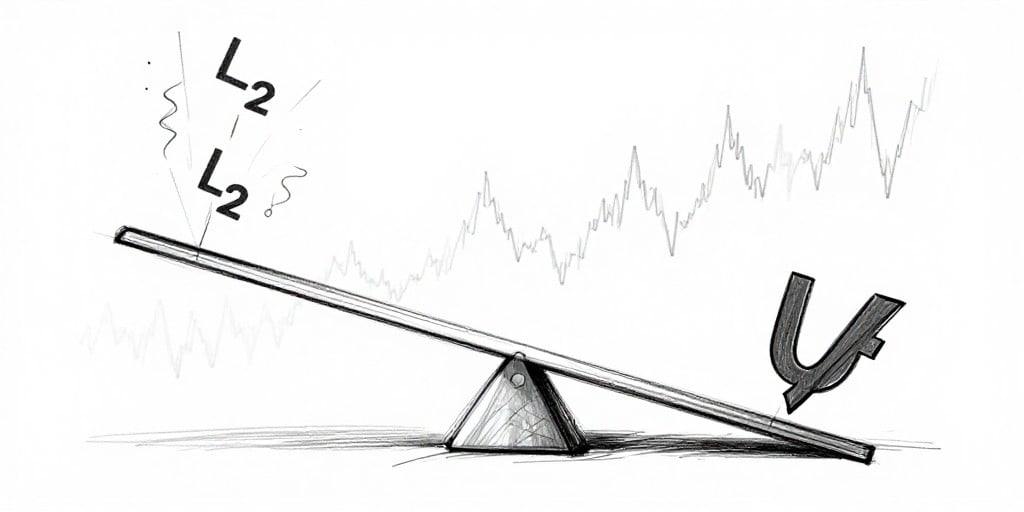
Uniswap’s Unsettled Trajectory in a Volatile Market
The market’s recent turbulence has cast a harsh light on Uniswap’s standing among the large‑cap altcoins. While the cryptocurrency sector as a whole has endured a roller‑coaster ride—Bitcoin settling at roughly $77,000 after a volatile swing and Ethereum climbing to an eight‑month high before succumbing to a sharp pullback—Uniswap’s performance has been less than stellar. According to DeFiLlama’s Movers dashboard, Uniswap is one of the assets that has begun to lose momentum in the last seven days, a trend that underscores a broader weakening of the token’s core DeFi proposition.
Market Context
Uniswap’s current price sits at $6.11458, a figure that reflects a steep slide from its 52‑week high of $10.0516. The asset’s 52‑week low, recorded on 2026‑06‑05, was $2.32774, suggesting that the token is still operating in a wide range of volatility. With a market capitalization of $3.800 billion, Uniswap remains a significant player, yet its recent price action reveals a loss of confidence that cannot be ignored.
The DeFi Landscape
The broader DeFi sector is experiencing a shift in momentum. Tokens that were leaders in August have seen their gains erode as yields climb and investor appetite recalibrates. Uniswap’s decline is particularly telling: it has been eclipsed by competitors that have managed to sustain or improve their relative performance over the past month. This is not merely a matter of price; it reflects a deeper erosion of liquidity, trading volume, and protocol usage.
Strategic Implications
Uniswap’s core strength has historically been its pioneering Automated Market Maker (AMM) model, which has attracted substantial liquidity and trading volume. However, the current market dynamics suggest that this model is no longer as compelling as it once was. Competing protocols—especially those that have embraced Layer‑2 scaling solutions and more efficient fee structures—are outpacing Uniswap in both user acquisition and token utility. This competitive pressure could translate into a sustained decline in Uniswap’s market share unless decisive action is taken.
Conclusion
Uniswap’s current trajectory is a stark reminder that dominance in the early DeFi era does not guarantee future relevance. The token’s declining price, coupled with its diminishing relative performance in the DeFiLlama dashboard, signals a critical juncture. Stakeholders must scrutinize whether Uniswap can innovate beyond its legacy AMM framework or whether the protocol will continue to slip into a peripheral role as the market rewards agility, scalability, and fresh utility.