
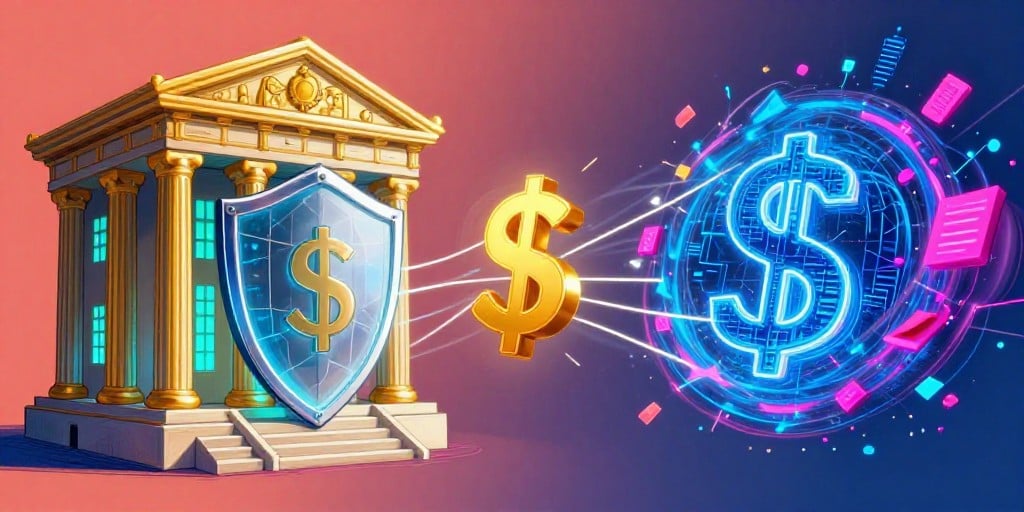
USDC Holds Ground as Circle Secures Federal Banking Charter, While Bonzo Lend’s Oracle Breach Shakes Confidence in DeFi
The U.S. dollar‑pegged stablecoin USDC remains remarkably stable today, closing at $0.999839—a fraction of a cent below its 52‑week low of $0.996673 and a whisper above its 52‑week high of $1.00496. Its market capitalization of $73.3 billion underscores its entrenched position in the crypto ecosystem, even as regulatory and technical shocks reverberate.
1. Circle’s National Trust Bank: A Regulatory Milestone with Strategic Implications
On July 10th, the U.S. Office of the Comptroller of the Currency (OCC) granted Circle Internet Group the green light to establish a National Trust Bank. This approval, announced across multiple outlets—including ambcrypto.com, cryptodaily.co.uk, and coingape.com—signals a pivotal shift in how stablecoins can operate within the U.S. regulatory framework. The banking charter will allow Circle to:
- Anchor USDC on regulated banking infrastructure – moving the stablecoin’s custody and settlement from decentralized custodians to a federally‑licensed institution.
- Expand liquidity and settlement capabilities – enabling larger, institutional‑grade transactions with greater auditability.
- Mitigate regulatory risk – by aligning with the OCC’s stringent compliance standards, Circle can assuage concerns that have plagued other stablecoin issuers.
The market has reacted aggressively: Circle’s shares surged between 10 % and 15 % in pre‑market trading, reflecting investor confidence that the new charter will unlock fresh use cases for USDC, from cross‑border payments to institutional lending. For USDC, the move means a tighter peg to U.S. dollar reserves, as the bank’s deposit base will be subject to rigorous supervisory oversight.
2. Bonzo Lend’s Oracle Exploit: A Cautionary Tale for DeFi
While USDC enjoys regulatory endorsement, the DeFi space remains volatile. The Bonzo Lend platform on Hedera suffered a $9 million oracle exploit that slashed its Total Value Locked (TVL) by 77 %. Detailed analysis on bitcoin2go.de and cryptodaily.co.uk reveals a sophisticated attack vector:
- Manipulated price feeds: A borrower submitted falsified price data, causing collateral valuations to plummet.
- Rapid liquidation failure: The platform’s verifier gap allowed the attacker to drain collateral before the system could correct the feed.
- Massive liquidity drain: Nearly $9 million in stablecoins and wrapped HBAR were extracted, destabilizing the protocol’s financial health.
This incident underscores the fragility of on‑chain data integrity. For USDC users and liquidity providers, it is a stark reminder that even well‑regulated stablecoins can be exposed indirectly through DeFi protocols that rely on them as collateral.
3. Market Repercussions and Investor Sentiment
- USDC’s price stability suggests that institutional demand for a reliably pegged digital dollar continues to outweigh fears of regulatory crackdowns or DeFi exploits.
- Circle’s banking charter has already translated into positive equity performance, hinting at future revenue streams from fee‑based services, custody, and possibly inter‑bank settlement of USDC.
- Bonzo Lend’s collapse has intensified calls for robust oracle governance. Several exchanges and protocols are revisiting their oracle architectures, a development that could reshape DeFi risk models and, by extension, USDC’s collateral usage.
4. Looking Ahead: Institutional Adoption vs. Decentralized Innovation
The juxtaposition of regulatory progress and technical failure paints a nuanced picture:
- Institutional adoption is accelerating. The Hyundai “real‑world adoption” of USDT on Avalanche, which cut transfer times to 7 minutes, demonstrates how corporate treasuries are leveraging stablecoins for cross‑border liquidity. If USDC follows a similar path—backed now by a federal bank—it could see a surge in corporate treasury use.
- Decentralized innovation remains a double‑edged sword. While platforms like Bonzo Lend push the envelope in liquidity provision, they also expose systemic vulnerabilities that can ripple back to the core stablecoin ecosystem.
5. Conclusion
USDC’s steadfast price amid Circle’s landmark banking approval showcases the stability that comes with regulatory alignment. Conversely, the Bonzo Lend oracle breach reminds stakeholders that decentralized ecosystems still harbor significant risk. Investors and corporate treasuries must weigh the promise of institutional infrastructure against the ever‑present threat of on‑chain exploits. The coming weeks will reveal whether USDC can sustain its peg and expand its role as the digital dollar of choice, even as the DeFi landscape continues to evolve—and sometimes, unravel.