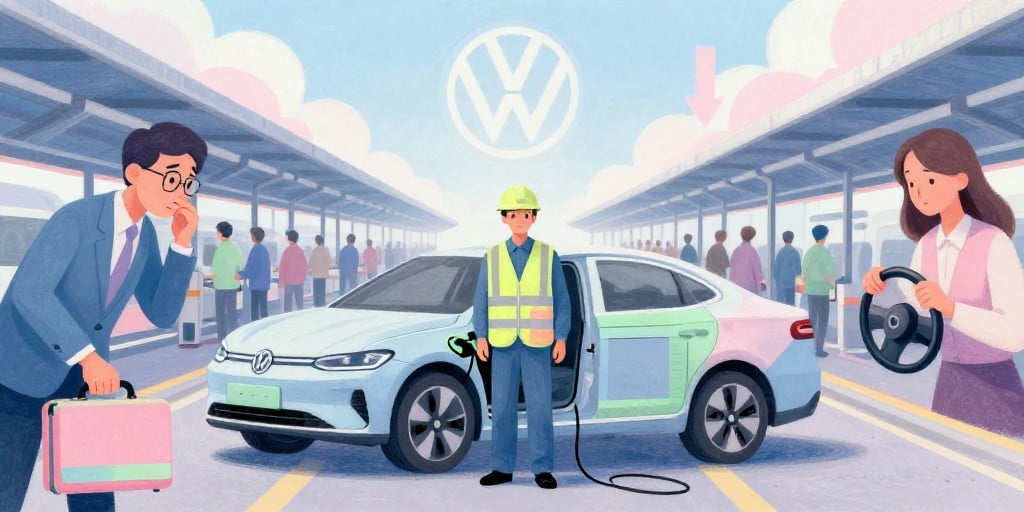
Volkswagen AG: A Moment of Reckoning in the Auto‑Industry
The latest market flare‑ups around Volkswagen AG (VW) reveal a company caught between its storied past and an uncertain future. While the German automaker’s share price lingered at €83.05 on 16 September 2026—a modest decline from the €110.2 high reached last December—analysts are warning that the underlying fundamentals have eroded, and that the firm’s strategic bets may soon prove costly.
1. Stock Performance Under Scrutiny
A recent article from finanzen.net quantified the losses that investors would have incurred if they had held VW shares for the past year. The article underscored the 52‑week low of €71 reached in June 2026 and highlighted the company’s price‑earnings ratio of 7.58, a figure that sits comfortably below the sector average but still signals limited growth prospects. The market cap of €43.1 billion further illustrates that VW, although massive, is no longer the uncontested giant it once was.
The DAX 40 exposure to VW is a clear warning sign. When a single constituent can drag the entire index, it is time to ask whether the company’s valuation is justified or merely a reflection of market hype.
2. Product Announcements – A Mixed Bag
In Wolfsburg, the company unveiled the ID.3 GTI, an ambitious attempt to combine the compact, electric ID.3 platform with a sporty character. While the press release from IT‑Times praised the new battery design, it failed to address the core question: will the GTI attract enough buyers to offset declining sales of the more traditional gasoline models? The world premiere of a new “Kleinwagen” in an era dominated by SUVs and cross‑overs seems, at best, a desperate bid to re‑ignite interest.
Simultaneously, the Environment Agency’s call for a rapid shift to electrification—driven by soaring gasoline prices—puts VW in a difficult position. The agency’s message suggests that the current transition is not just desirable but necessary, yet VW’s public statements have yet to demonstrate a clear, actionable path forward.
3. Labor Relations and Job Security
Volkswagen’s corporate governance has come under intense scrutiny. Sharedeals reported that the company’s works council chair, Daniela Cavallo, has demanded legally binding employment guarantees. This demand follows rumors of 100,000 jobs at risk across the group—an alarming figure for a company whose core business model has been built on mass production.
The looming threat of job cuts could undermine the company’s ability to invest in new technology and maintain its manufacturing footprint. If Volkswagen’s workforce erodes, so will its competitive edge in a market that increasingly rewards agility and rapid innovation.
4. External Economic Pressures
Interest rates are rising globally. While the KLSescreener article discusses potential hikes in Malaysia’s policy rates, the underlying trend is clear: higher borrowing costs will squeeze consumer spending. In a market where automotive purchases are typically financed, any uptick in rates can suppress demand. VW’s price‑earnings ratio of 7.58, while modest, may not be sufficient to absorb the additional financial friction.
The Fed’s recent decision to lower gold prices, as reported by ntg24.de, signals broader monetary tightening. This tightening environment could further dampen discretionary spending, directly impacting VW’s sales volume.
5. Strategic Alliances – A Ray of Hope or a Red Flag?
The company’s involvement in global collaborations, such as the partnership with Xpeng revealed by stock.eastmoney.com, shows a willingness to engage with emerging technologies. However, these collaborations are still nascent, and it remains unclear whether they will translate into tangible revenue streams. The fact that Xpeng is looking to expand its technology output beyond VW hints at a possible dilution of exclusivity that could erode VW’s brand value.
6. Bottom Line: An Urgent Call for Action
Volkswagen AG stands at a crossroads. Its share price has slipped below its 52‑week low, its workforce is under threat, and its strategic moves—such as the ID.3 GTI launch—are insufficient to counteract broader industry shifts towards electrification and cost‑effective manufacturing. The company’s valuation is under pressure, and the market’s patience is waning.
If VW does not accelerate its transition to fully electric, secure its jobs, and clearly communicate a realistic path forward, it risks becoming a cautionary tale in the automotive sector. Investors, consumers, and employees alike must recognize that the era of the “Volkswagen miracle” may be drawing to a close.