
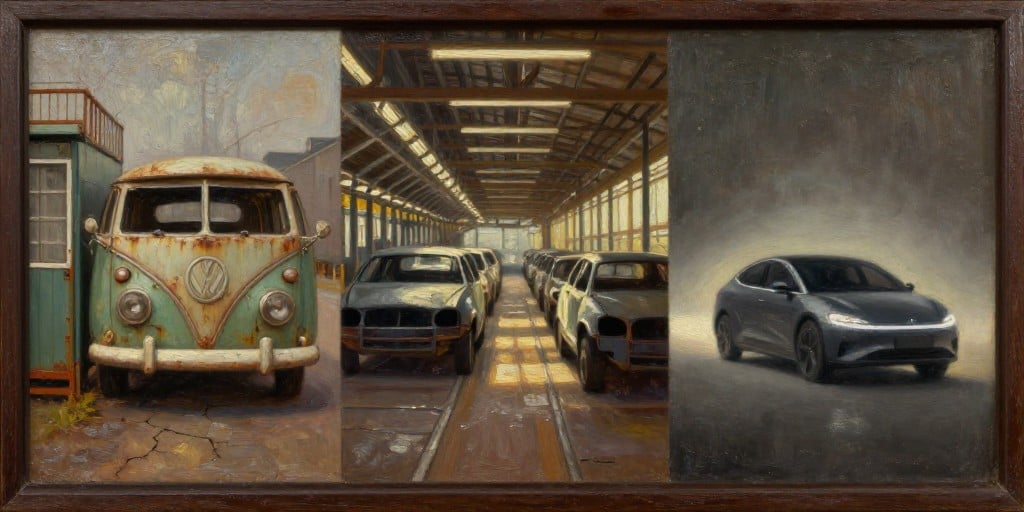
Volkswagen AG Faces a Stark Reckoning: The Road to Recovery Is Shaky
Volkswagen AG, the German automotive titan that once reigned supreme in both economy and luxury segments, is now trapped in a maelstrom of operational turbulence and investor disillusionment. A series of stark headlines and market signals paint a picture of a company struggling to regain the 10‑million‑unit annual production target it once touted. The crisis is not merely a temporary setback; it is a symptom of deeper structural flaws that threaten to erode the firm’s market valuation and shareholder value.
Production Ambitions vs. Reality
On July 2, 2026, finanznachrichten.de reported that Volkswagen “hopes for a return to over ten million cars.” This headline, while optimistic, is misleading in light of recent developments. The company’s 2025–2026 trajectory shows a sharp decline in sales and a relentless erosion of production capacity. The 52‑week low of €71 per share underscores a market that has lost confidence in the company’s ability to deliver on its ambitious output.
The company’s stated goal of exceeding ten million units per year is not supported by current production data or the company’s recent restructuring plans. Instead, Volkswagen is confronting a looming workforce contraction: the board has announced a 100,000‑job cut and the closure of four factories, including the strategically important Zwickau plant in Saxony. Such drastic measures are a clear signal that the firm’s current production model is unsustainable and that it may be forced to pivot away from mass production altogether.
Investor Sentiment and Market Dynamics
Investor sentiment has turned sharply negative, reflected in a series of daily market reports. On June 30, 2026, verumo.de noted that the VW share price continued to slide, adding that “speculation about unprecedented layoffs is accelerating the recent price collapse.” Simultaneously, 4investors.de reported that European equity markets were on edge, with volatility driven by geopolitical tensions and uncertain monetary policy.
The share price’s volatility is further amplified by the firm’s low price‑earnings ratio of 5.83, which suggests that the market is already demanding a discount for the risk it perceives. While this could be interpreted as a buying opportunity for value investors, the surrounding narrative—particularly the repeated reference to job cuts and factory closures—casts doubt on whether such a discount is justified by the company’s long‑term prospects.
Strategic Pivot to Electrification and New Technologies
Despite the bleak outlook, Volkswagen has not abandoned innovation entirely. Recent statements from former CEO Herbert Diess (now CEO of a different German automaker) highlight that bidirectional charging is “ready for mass market deployment,” signaling that the industry is approaching a “tipping point” for electric vehicle (EV) infrastructure. The company’s involvement in this area, however, remains speculative: there are no concrete production timelines or revenue projections attached to these initiatives.
The broader industry context reinforces Volkswagen’s precarious position. Competing firms—most notably BMW, which has recently tightened its annual outlook—are presenting more stable growth trajectories. Volkswagen’s failure to match or exceed these benchmarks is a critical weakness that is eroding its competitive standing.
Financial Snapshot
- Market Cap: €35.62 bn
- Current Share Price (30 Jun 2026): €72.35
- 52‑Week High: €110.20
- 52‑Week Low: €71.00
- Price/Earnings Ratio: 5.83
These numbers, while still reflecting a sizeable enterprise, illustrate a company whose valuation is eroding under the weight of operational challenges and market skepticism.
Conclusion
Volkswagen AG’s path to recovery is fraught with uncertainty. While the firm’s public statements emphasize a return to mass production and a strategic shift toward electrification, the simultaneous announcement of massive layoffs, plant closures, and a declining share price indicate that the company is in the throes of a crisis rather than a transformation. The market’s reaction—evidenced by a steep decline in share value and a low P/E ratio—suggests that investors are not yet convinced that Volkswagen can reverse its fortunes.
In an industry where technological agility and production reliability are paramount, Volkswagen’s current trajectory threatens to undermine its legacy as a global automotive leader. The company’s future will hinge on whether it can convincingly demonstrate a viable, profit‑generating pathway that aligns with the realities of a rapidly evolving automotive landscape.