
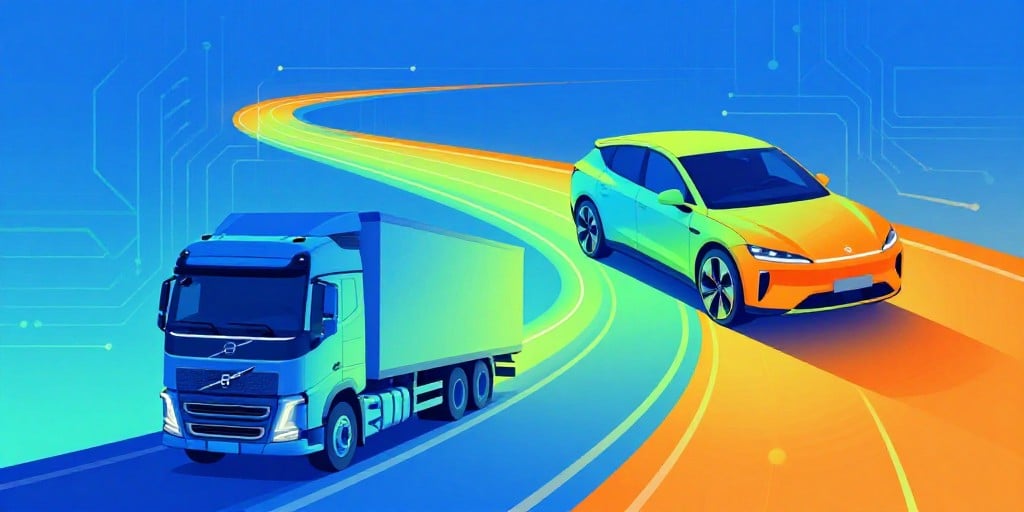
Volvo A Faces a Crucial Pivot to Electric Mobility
The Swedish giant AB Volvo, long celebrated for its heavy‑duty trucks, buses, and construction machinery, is now being forced to confront a new reality: electrification. Two pieces of recent news underscore the urgency and the stakes.
1. A Shift from Limousines to Electric‑SUVs
On 31 July 2026, Smartdroid reported that Volvo’s historic association with luxury limousines and family‑sized kombis is giving way to a new product line—a fully electric sport‑utility vehicle. While the company’s core businesses remain in heavy machinery and marine engines, this announcement signals a strategic diversification into the consumer market, traditionally dominated by automotive manufacturers like Tesla and BYD. The move is not merely about tapping a high‑margin segment; it reflects the pressure to maintain relevance as global demand for zero‑emission vehicles swells.
2. A Massive Investment in Electric Trucks
On 1 August 2026, Resources.org highlighted that Volvo, alongside Daimler Truck and Traton, is pouring billions into electric truck portfolios. The article questions whether every diesel lorry truly needs replacement, but the implication is clear: Volvo is aligning itself with a broader industry pivot toward cleaner freight transport. This investment signals a commitment to electrification that extends beyond the consumer‑vehicle segment and into the very backbone of its traditional revenue streams.
Financial Context
Volvo A’s market position is anchored by robust fundamentals:
| Metric | Value |
|---|---|
| Close Price (2026‑07‑30) | 365.2 SEK |
| 52‑Week High | 370.2 SEK |
| 52‑Week Low | 245.2 SEK |
| Market Cap | 745 bn SEK |
| P/E Ratio | 22.59 |
These figures reveal a company with significant valuation upside potential. The price sits just 5 % below its recent high, suggesting that investors are already pricing in a future of growth. The P/E ratio, while moderate, reflects the market’s willingness to pay a premium for a firm positioned at the intersection of industrial machinery and emerging electric mobility.
Strategic Implications
Diversification Risks Transitioning from heavy machinery to consumer electric‑SUVs exposes Volvo to a new competitive arena. Established automakers possess deep expertise in infotainment, connectivity, and mass‑production efficiencies—areas where Volvo’s experience is limited. If the electric‑SUV fails to gain traction, the company could face significant sunk costs.
Capital Allocation The billions earmarked for electric trucks will strain capital budgets and may necessitate higher debt or equity issuances. Investors must assess whether the projected returns from this electrification drive justify the immediate dilution or debt servicing costs.
Supply Chain Reconfiguration Electric vehicles demand different components—lithium‑ion batteries, power electronics, and advanced software—that differ fundamentally from the parts that power Volvo’s trucks and marine engines. The company will need to overhaul supplier relationships, potentially incurring costly re‑engineering and certification expenses.
Regulatory Momentum Governments worldwide are tightening emissions standards, and the shift to electric freight could become mandatory in many regions. Volvo’s investment positions the company to comply with future regulations, potentially securing lucrative government subsidies and avoiding penalties.
Market Timing The industry is witnessing a rapid acceleration of electrification, with competitors like Daimler and MAN already announcing similar strategies. Volvo’s timing—announcing an electric‑SUV just days before a major truck electrification push—may be a calculated attempt to capture first‑mover advantage in both passenger and freight markets.
Conclusion
Volvo A stands at a crossroads. Its historical dominance in heavy machinery and marine engines has earned it a formidable market cap and a respectable valuation. Yet the company’s recent forays into electric‑SUVs and the massive capital outlay for electric trucks signal a decisive pivot toward a cleaner, more diversified portfolio. The gamble is substantial: success could cement Volvo’s place as a global leader in electrified transport; failure could dilute its core strengths and erode shareholder value. Investors, therefore, must scrutinise whether the company’s strategic vision is supported by realistic execution capabilities and whether the financial metrics can sustain the transition.