
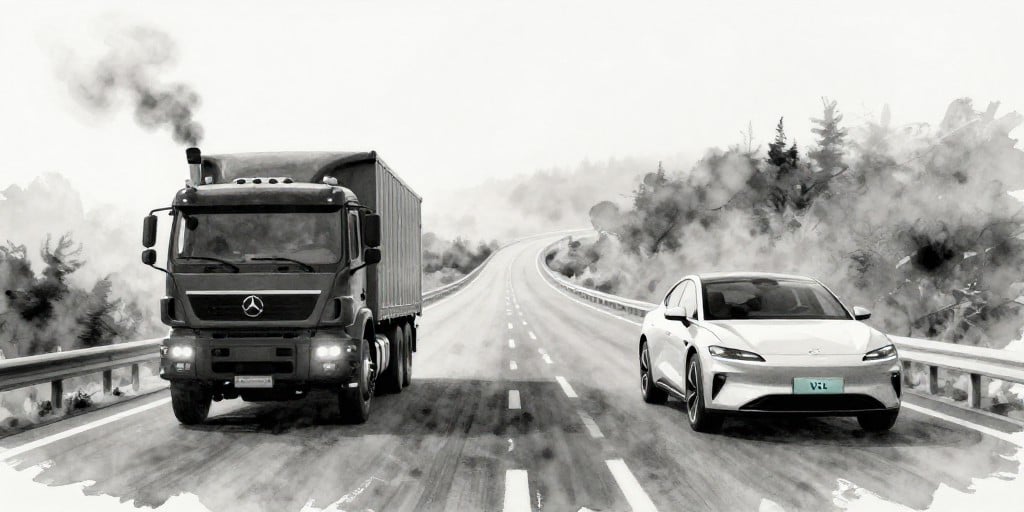
Volvo’s Dual‑Track Dilemma: Trucks, Cars, and the Electrified Future
The Swedish industrial giant AB Volvo (market cap 703 b SEK, P/E 19.68) is caught in a paradox that could decide its fate for decades. Its truck and construction‑equipment arm remains a global benchmark for heavy‑duty performance, yet its car division is struggling to keep pace with electrification, sales volatility, and a surging short‑interest ratio. The company’s latest moves—shifting Stockholm staff to Gothenburg, converting Series A to Series B shares, and pushing aggressive EV updates—signal a frantic scramble to stay relevant in a market that is tightening on both the diesel and battery fronts.
Heavy‑Duty Heritage Meets a Shifting Market
Volvo Construction Equipment (VCE) continues to dominate the “dance of the building giants,” with a fleet that spans continents from Europe to Oceania. The sector’s 52‑week high of 374.5 SEK (Aug 4) and a 52‑week low of 244.9 SEK (Oct 16, 2025) illustrate the volatility that accompanies a product line still tethered to fossil fuels. In a recent analysis, Carbon Tracker projected that battery‑electric trucks could become competitive with diesel by the early 2030s—an outcome that would upend VCE’s core value proposition.
Volvo Trucks’ own leadership is already acknowledging hydrogen as a key element of de‑carbonisation. Yet the company faces an uphill battle: its sales of electrified vehicles grew 13 % in the last quarter, yet total car sales fell 7.4 % year‑on‑year (148,239 units for Q3 2026). The downward trend is reflected in the sharp rise in short interest—an increase of 67.7 % in August, with 5.8 million shares held short against a trading volume of roughly 1,060 shares per day. This signals a growing sentiment that Volvo’s automotive arm may be overvalued relative to its earnings trajectory.
A New Generation of Connected EVs
While the truck division grapples with market uncertainty, Volvo Cars is aggressively expanding its electrified footprint. The EX30, now offering a Vehicle‑to‑Load (V2L) function through a software update, can power a campsite or a coffee maker—an illustration of the brand’s attempt to re‑define “everyday use” for EV owners. The EX60 and EX90 are also being networked to warn drivers of animals, construction zones, and accidents, a move that underlines Volvo’s commitment to safety‑first autonomous technology.
In India, the ES90 is set to launch on 12 Oct 2026. With a WLTP range of 664‑696 km and 350 kW charging speeds, the sedan promises to compete on both range and performance. The launch could also be a strategic pivot: Volvo had recently retired the S90 sedan, signalling a willingness to recalibrate its lineup to align with emerging demand for long‑range, high‑speed EVs.
Corporate Restructuring Amid Strategic Uncertainty
The company’s executive leadership has not ignored the internal implications of these external pressures. In August, Volvo moved a significant portion of its Stockholm staff to the Gothenburg headquarters, a cost‑saving measure that also consolidates operations around the core manufacturing hub. The simultaneous conversion of 195 Series A shares to Series B shares reflects a broader effort to streamline governance and potentially attract new equity investors who favor the more liquid Series B structure.
Yet, these corporate maneuvers could be double‑edged. While they may reduce overhead and simplify shareholder structure, they also risk eroding employee morale and could be perceived as a retreat from the company’s historic Swedish roots. In an industry where brand identity can be as valuable as technology, such moves warrant scrutiny.
The Verdict: A Company at a Crossroads
Volvo’s trajectory is a litmus test for the broader industrial sector’s adaptation to electrification. On one side, its construction and truck divisions are still entrenched in diesel‑centric markets that are under increasing regulatory pressure. On the other, its automotive arm is investing heavily in connected EVs, V2L technology, and rapid‑charging infrastructure—yet sales remain in decline and short interest is surging.
The company’s current valuation (P/E 19.68) does not appear to fully capture the risks of a rapidly changing market or the opportunities that electrified heavy‑duty vehicles may present. Investors, analysts, and customers alike will watch closely as Volvo attempts to reconcile its legacy strengths with the relentless march toward a zero‑emission future.