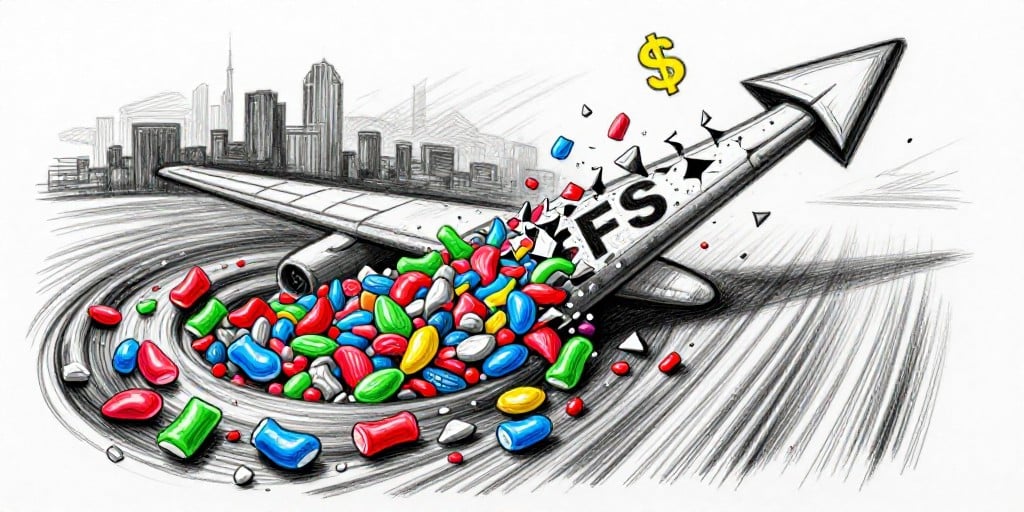
Wingstop Inc. – A Cautionary Tale of Ambition and Weakness
Wingstop Inc. (NASDAQ: WING) is a restaurant chain that has long been marketed as a fast‑food specialist with a global footprint. Yet the latest data and corporate announcements paint a picture that is far less glamorous than the company’s marketing suggests.
1. Sales Momentum at a Standstill
The most striking metric is the decline in domestic same‑store sales. In the third quarter of fiscal 2026, domestic same‑store sales fell by 5.4 %, a sharper drop than the 5.6 % decline reported in the previous quarter. This trend is confirmed in a separate announcement that the company “reports another quarter of negative U.S. same‑store sales.”
Despite a headline‑grabbing 6 % increase in system‑wide sales (to $1.4 billion), the underlying driver is largely digital, with 73.7 % of system‑wide sales coming from digital channels. The company’s strategy to push digital sales cannot compensate for the erosion of its core, brick‑and‑mortar business.
2. Expansion Goals That May Be Overreaching
In a recent outlook, Wingstop forecasted a 6.5 %–7 % decline in domestic same‑store sales for 2026 while simultaneously targeting 440–450 net new restaurants. This juxtaposition reveals a fundamental tension: the company is betting on volume growth to offset declining per‑store performance.
Moreover, the company’s ambitious expansion into India—highlighted by a “sluggish U.S. sales” press release—offers a distraction rather than a solution. While the India strategy may eventually pay off, the current U.S. trajectory suggests that the expansion will only add to the company’s dilution of focus and resources.
3. Earnings: Modest Growth Amidst Operational Drag
Wingstop’s Q3 2026 net income rose by 2.2 % to $29.1 million, or $1.07 per diluted share. However, the adjusted net income and adjusted EBITDA—the non‑GAAP measures that better capture operating performance—fell by 3.5 % to $29.3 million and rose only 0.5 % to $64.0 million, respectively.
These figures illustrate the company’s struggle to translate growth in system‑wide sales into meaningful operating gains. The Royalty revenue, franchise fees and other increased by $5.1 million, largely thanks to net‑new franchise development, but this benefit is partially negated by the $3.6 million drop in domestic same‑store sales.
4. Dividend Signals and Shareholder Sentiment
Wingstop declared a modest $0.33 dividend per share—a move that appears designed to placate shareholders rather than reward them. This dividend comes at a time when the company’s valuation, with a price‑to‑earnings ratio of 28.59, is already stretched, especially considering the company’s $3.3 billion market cap.
5. The Market’s Reaction: A Short‑Squeeze Narrative
On the day of the earnings announcement, Wingstop’s stock experienced a sharp spike, attributed to a short‑squeeze. While this rally provided a temporary boost, it is a symptom of market speculation rather than a reflection of underlying business strength.
6. Bottom Line: A Company in a Growth‑Loss Trade‑Off
Wingstop is caught in a paradox: it is aggressively expanding while its core domestic operations are deteriorating. The company’s confidence in its “robust development pipeline” and “significant global whitespace” is undermined by the stark reality of declining same‑store sales, modest earnings improvements, and a reliance on digital channels that cannot fully substitute for foot‑traffic.
Unless Wingstop can reverse its domestic sales decline, the company’s aggressive expansion strategy risks becoming a drain on capital and a source of dilution. Investors should be wary of the company’s lofty ambitions in the face of persistent operational weakness.