Wuliangye Yibin Co., Ltd.: A Liquor Giant Caught in a Market’s Ice‑Bite
Wuliangye Yibin Co., Ltd., a stalwart of China’s consumer‑staples sector, has long been celebrated for its flagship Wuliangye series of liquors. The company’s stock, traded on the Shenzhen Stock Exchange, closed at 75.1 CNY on 2026‑11‑03, a modest decline from its 52‑week high of 122.5 CNY set on 2025‑11‑11. While its market cap stands at a staggering 293 billion CNY, the firm’s price‑to‑earnings ratio of 23.87 signals that investors still harbor optimism, albeit tempered by a market in distress.
1. The Industry’s Squeeze
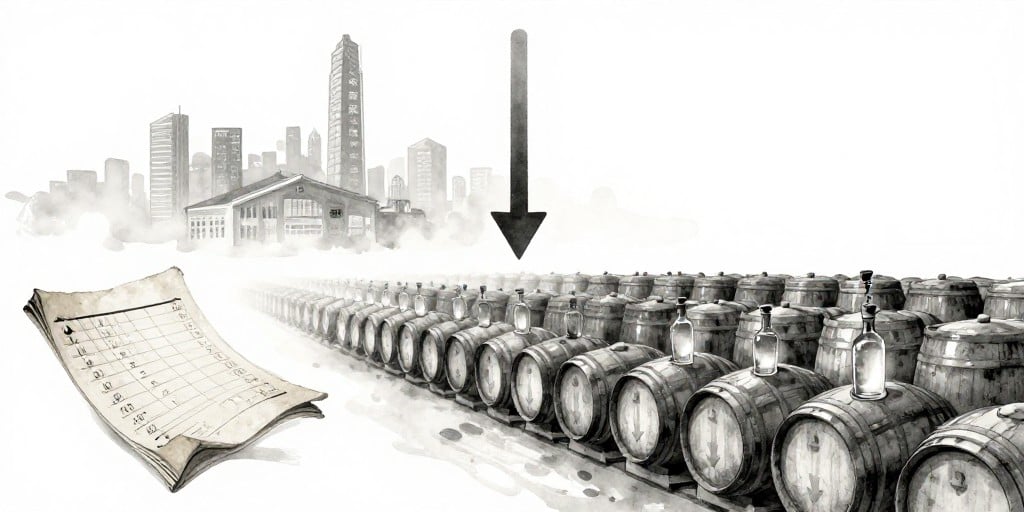
The latest quarterly reports from 19 leading Baijiu firms reveal a bleak picture: total revenue fell 7.64 % to 265.5 billion CNY, and net profit sank 9.44 % to 97.4 billion CNY. These figures underscore a deep, ongoing adjustment in the Chinese liquor market, where channels are forced to liquidate inventory and manufacturers are forced to abandon short‑term scale in favor of clearing stale stock.
Wuliangye, despite its brand strength, is not immune. The firm’s own production portfolio extends beyond liquors into carbon, lactic acid, and printing and packaging materials, yet the overarching demand shock has rippled across every sub‑segment. The 52‑week low of 68.68 CNY—recorded on 2026‑09‑29—reflects the immediate impact of inventory reductions and price pressure on the share price.
2. Stock Performance Amid Sectoral Tumult
On 2026‑11‑04, the Baijiu sector opened with a modest rally in the broader indices, but the Baijiu index itself closed 0.55 % lower. Within that decline, Wuliangye’s share price dropped 0.60 % to 75.10 CNY, trailing the market’s modest gains and lagging behind rivals such as Maotai and Wuliangye’s competitor, Wuliangli. The drop is symptomatic of a sector where even premium brands are forced to reassess their pricing strategy.
In contrast to the sector’s downward momentum, other Baijiu stocks—such as Luzhou Laojiao and Shanxi Fenjiu—also posted declines, evidencing that the market is not merely correcting a single misstep but confronting a systemic inventory and demand problem.
3. Corporate Strategy Under Scrutiny
The company’s historical resilience, demonstrated by its 1998 public listing, now faces scrutiny as the firm must reconcile its traditional product lines with the shifting consumer landscape. While the company’s website lists its extensive product range, the absence of any aggressive diversification strategy in the current reports suggests a reactive posture rather than a proactive transformation.
Analysts point out that the decline in contract liabilities—reported for 14 of the 19 Baijiu firms—indicates a shrinking supply chain and tighter credit lines. Wuliangye’s inability to fully capitalize on this trend could expose the firm to liquidity risks, especially given its sizeable market cap and the need for sustained capital to support marketing and distribution in a tightening market.
4. Capital Movements and Investor Sentiment
The broader A‑share market witnessed a notable shift in fund flows on 2026‑11‑04, with fund managers taking opposite stances on the Baijiu theme. While blue‑chip strategies saw increased positions, supply‑side reform funds pulled back, reflecting divergent expectations for the sector’s recovery. Wuliangye’s modest share price decline, coupled with its high PE ratio, suggests that institutional sentiment is wary of the company’s ability to reverse the downward trajectory.
In the days preceding the market data release, the Chinese regulatory framework for financial markets received attention, with the State Council discussing monetary policy and regulatory tightening. These macro‑policy signals, while aimed at stabilizing the broader economy, add another layer of uncertainty for companies like Wuliangye that rely on consumer discretionary spending.
5. The Road Ahead
The company’s prospects hinge on several factors:
- Inventory Management – Effective clearance of channel stock is essential to restore pricing power.
- Product Innovation – Diversifying the portfolio beyond traditional liquor could mitigate the impact of a saturated market.
- Capital Allocation – Prudently managing capital to support marketing and distribution, while avoiding excessive leverage.
- Regulatory Compliance – Adapting to evolving financial regulations to maintain investor confidence.
Wuliangye Yibin Co., Ltd. has carved out a legacy as a premium Baijiu producer, yet the current market conditions demand decisive action. If the firm continues to lean on its historical brand equity without adapting to the new dynamics of inventory and consumer demand, it risks being eclipsed by more agile competitors. Conversely, a bold reorientation could position it not only as a survivor but as a leader in a revitalized industry.
This analysis draws exclusively from the provided fundamental data and contemporaneous news reports, reflecting the most pressing issues confronting Wuliangye Yibin Co., Ltd. in the present market environment.