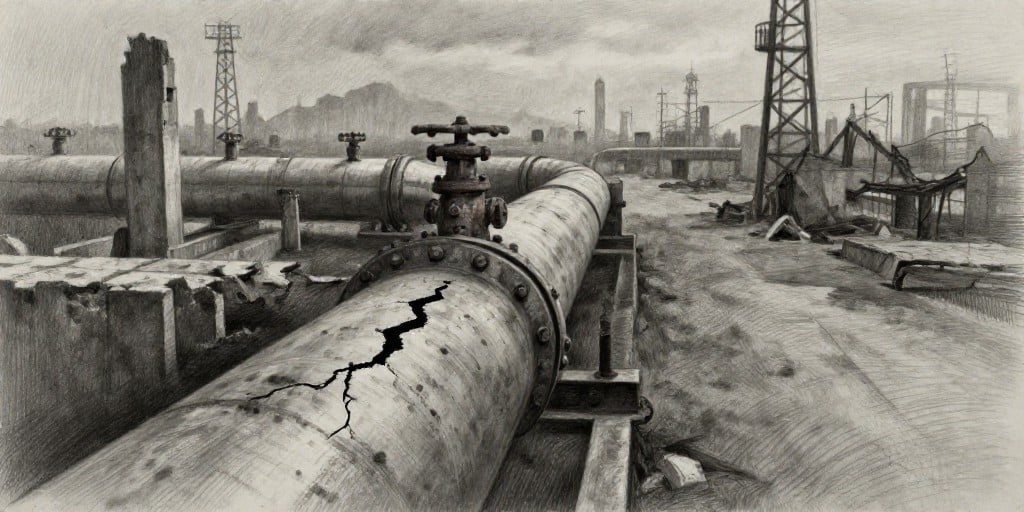
The Case of Xinjiang Guotong Pipeline: Overshadowed, Undervalued, and Potentially Poisoned
The recent market sweep that saw the Shenzhen and Shanghai indices tumble, coupled with a flurry of sector‑specific gains, paints a portrait of an equity landscape dominated by fleeting sentiment rather than substantive fundamentals. Amid this cacophony, Xinjiang Guotong Pipeline Company Ltd. (Guotong) remains an outlier—its story barely mentioned, its performance still a question mark, and its valuation a glaring indictment of its financial health.
1. A Dismal Snapshot of Financial Health
Guotong’s close price on 2026‑11‑11 was a paltry CNY 11.75, a sharp drop from the 52‑week high of CNY 18.94. More alarming is the fact that its 52‑week low—CNY 8.65—was breached not long ago, underscoring a persistent downward trajectory. The company’s market cap, CNY 1.98 billion, barely scratches the surface of what one would expect for a firm positioned in a critical infrastructure niche.
The price‑earnings ratio, a standard gauge of valuation, sits at a disconcerting –9.61. A negative P/E signals that Guotong is not just underperforming; it is in the red, incurring losses that eclipse any earnings potential. In a sector where profitability and cash flow are paramount—especially for a manufacturer of prestressed concrete pressure pipes (PCCP) that serve the lifeblood of water transport—such a ratio is a red flag, not a rallying cry.
2. Market Sentiment Is Far From Favorable
The broader market environment offers no respite for Guotong. On 2026‑11‑13, all three major indices—Shanghai Composite, Shenzhen Component, and the ChiNext Index—declined, with the latter falling an alarming 3.32 %. The index movements suggest that investors are shunning growth stocks, preferring defensive plays or sectors that have already outperformed.
The news also highlights that only a handful of sectors—film, alcohol, animal husbandry, rural banks—experienced gains. Building products, the industry in which Guotong operates, did not appear on the list of rising sectors. In an economy where infrastructure investment is touted as a driver of growth, a sector that remains dormant in the investor’s eye is a symptom of misaligned capital allocation.
Moreover, the 77 stocks that broke their six‑month moving averages on 2026‑11‑12 were all tied to sectors that were trending upward. Guotong’s absence from this list further underscores its lack of momentum. The market’s attention is firmly on other stories; Guotong’s narrative is drowned out by a chorus of louder, more glamorous stocks.
3. The Industry Context: Building Products in a Vicious Cycle
The building products industry, by its very nature, is cyclical and highly sensitive to macro‑economic conditions. Guotong’s product line—prestressed concrete pressure pipes—serves a niche but essential market: water transport. Yet, even with the Chinese government’s push for “new infrastructure” and rural revitalization, the sector’s performance has been uneven.
While some building product firms have leveraged rising demand for construction materials, Guotong’s negative earnings suggest it has struggled to convert its production capacity into profitable sales. The company’s size—market cap under CNY 2 billion—makes it vulnerable to competition from larger, better‑capitalized peers who can absorb market shocks more effectively.
4. A Call for Strategic Reassessment
Given the evidence, the only rational conclusion is that Guotong requires a fundamental overhaul. The negative P/E is not a mere anomaly; it is a systemic failure of the business model. The company’s current valuation, hovering at a low price relative to its 52‑week low, signals that the market has already priced in a bleak outlook.
From a strategic standpoint, Guotong must answer several pressing questions:
- Cost Structure: Why is the company hemorrhaging cash? Are production efficiencies lagging behind competitors? Is the company over‑leveraged or over‑capitalized?
- Market Positioning: How can Guotong differentiate its PCCP product in a crowded field? Can it pivot to emerging markets or new applications, such as smart infrastructure or renewable energy pipelines?
- Capital Allocation: With a negative P/E and limited market cap, does the firm have the liquidity to invest in R&D, expand capacity, or acquire complementary businesses?
Until Guotong can convincingly address these questions, its stock remains a cautionary tale—an asset whose value is more symbolic than substantive.
5. The Bottom Line: Investor Caution is Imperative
In the current market climate, where indices are falling and the spotlight is on a handful of high‑growth sectors, investors should treat Guotong with the same caution they would reserve for a speculative play in a distressed industry. The company’s fundamentals do not support a bullish stance; its financials paint a picture of a business in distress, not a growth engine.
The story of Xinjiang Guotong Pipeline is one of being overlooked, undervalued, and potentially poisoned by its own financial mismanagement. In an era that rewards efficiency, innovation, and profitability, Guotong’s current trajectory signals a need for urgent reassessment—otherwise, its prospects are as bleak as its price chart.