
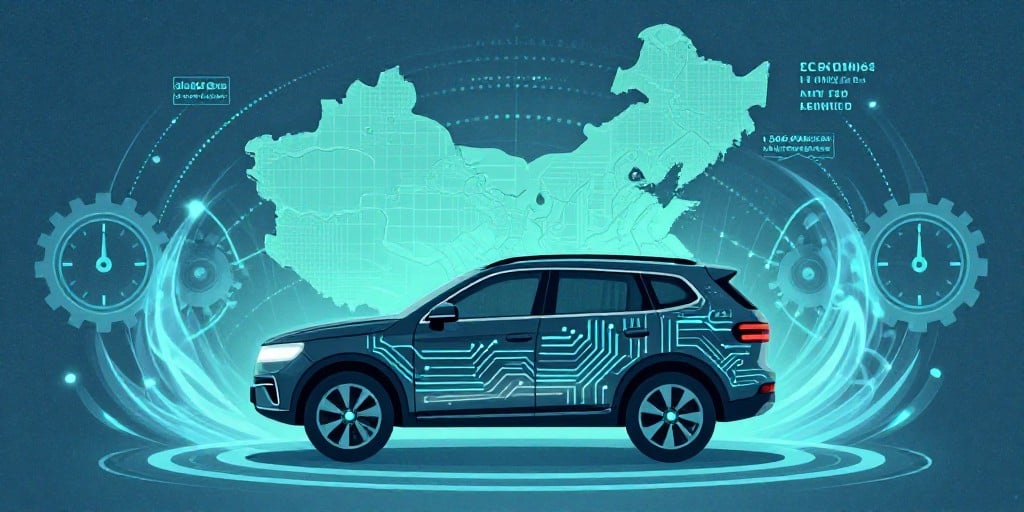
XPENG’s Aggressive Expansion and Ambitious Autonomous Roadmap
XPENG has once again thrust itself into the limelight, not with modest quarterly earnings but with a series of bold operational moves that signal an intent to dominate China’s rapidly evolving electric‑vehicle (EV) market. The company’s recent actions—delivering 1,300 vehicles to the prominent rental chain CAR Inc., opening pre‑sales for its new MONA L03 SUV, and announcing a 10 % increase in GX production—are all part of a coordinated strategy to cement its position across the entire consumer‑discretionary spectrum.
1. Massive Vehicle Delivery to CAR Inc.
CAR Inc., a leading player in the national car‑sharing arena, received a batch of 1,300 XPENG units, spanning the MONA M03, P7+, and X9 models. This deployment is more than a mere transaction; it is a calculated move to embed XPENG vehicles into high‑traffic tourist cities and key transportation hubs. By securing a foothold in the rental market, XPENG is effectively guaranteeing recurring mileage and exposure, thereby accelerating brand recognition and generating data that can feed into its AI‑driven autonomous systems.
2. Pre‑Sales Launch of MONA L03 SUV
XPENG’s MONA L03, now available for pre‑sale, offers both Battery‑Electric Vehicle (BEV) and Range‑Extended Electric Vehicle (REEV) variants. Deutsche Bank’s projection—12,500 units per month—underscores the market’s confidence in the model’s competitive positioning. The L03’s affordability, coupled with its rapid charging capabilities that surpass rivals like Volkswagen and Tesla, positions XPENG to capture the segment of consumers who prioritize cost‑effectiveness without sacrificing performance.
3. Commitment to L4/L5 Autonomous Commercialization
CEO He Xiaopeng has publicly articulated a “skip‑L3” strategy, advocating a direct leap from Level‑2 to Level‑4 and eventually Level‑5 autonomous driving within the next three to five years. His confidence is buttressed by the MONA M03’s cumulative delivery of over 280,000 units in just 674 days, and its sustained status as the top‑selling BEV sedan priced between RMB 100,000 and RMB 200,000 for 22 straight months. XPENG’s focus on intelligent assisted driving is not mere rhetoric; it is a calculated bet that AI will soon become a decisive differentiator in the Chinese market.
4. Production Upswing to Capture the Top‑Three Segment
The company plans a 10 % lift in GX output this month, a decisive step aimed at securing a top‑three position within the premium segment. This production boost aligns with the broader strategy of increasing scale while maintaining the high quality that distinguishes XPENG’s offerings. By doing so, XPENG reduces unit costs, enhances profitability, and strengthens its bargaining position with suppliers and partners alike.
5. Strategic Partnerships and Forward‑Looking Procurement
CAR Inc.’s pledge to procure an additional 5,000 XPENG vehicles over the next year is a tangible endorsement of XPENG’s product suite and an indicator of sustained demand. Moreover, the collaboration extends beyond mere sales, encompassing joint development of intelligent mobility scenarios, charging infrastructure, and co‑branding initiatives. Such alliances serve to lock in market share and create ecosystem lock‑in that competitors will find difficult to replicate.
6. Market Reception and Competitive Dynamics
Despite the company’s aggressive expansion, the broader Chinese EV landscape remains fiercely contested. While BYD has rebounded to growth, XPENG and other domestic rivals—such as Nio and Xiaomi—continue to battle for market share. XPENG’s focus on delivering high‑volume, affordable EVs, coupled with its AI ambitions, is a direct challenge to the incumbents’ dominance. The company’s ability to translate volume into profit, however, remains to be seen, given its current price‑earnings ratio of –40.68 and the volatility between its 52‑week low of 15.82 HKD and a high of 110.8 HKD.
7. Conclusion
XPENG’s latest operational milestones—mass delivery to a national rental chain, pre‑sales of a competitively priced SUV, and a strategic push toward Level‑4/5 autonomy—are not isolated events. They are manifestations of a coherent, high‑stakes plan to capture the lion’s share of China’s electric‑vehicle market. The company’s bold moves, backed by aggressive production scaling and strategic partnerships, set a new benchmark for what it takes to survive—and thrive—in one of the world’s most competitive automotive arenas.